European Identity and the Question of Belonging: When Expansion Includes Othering
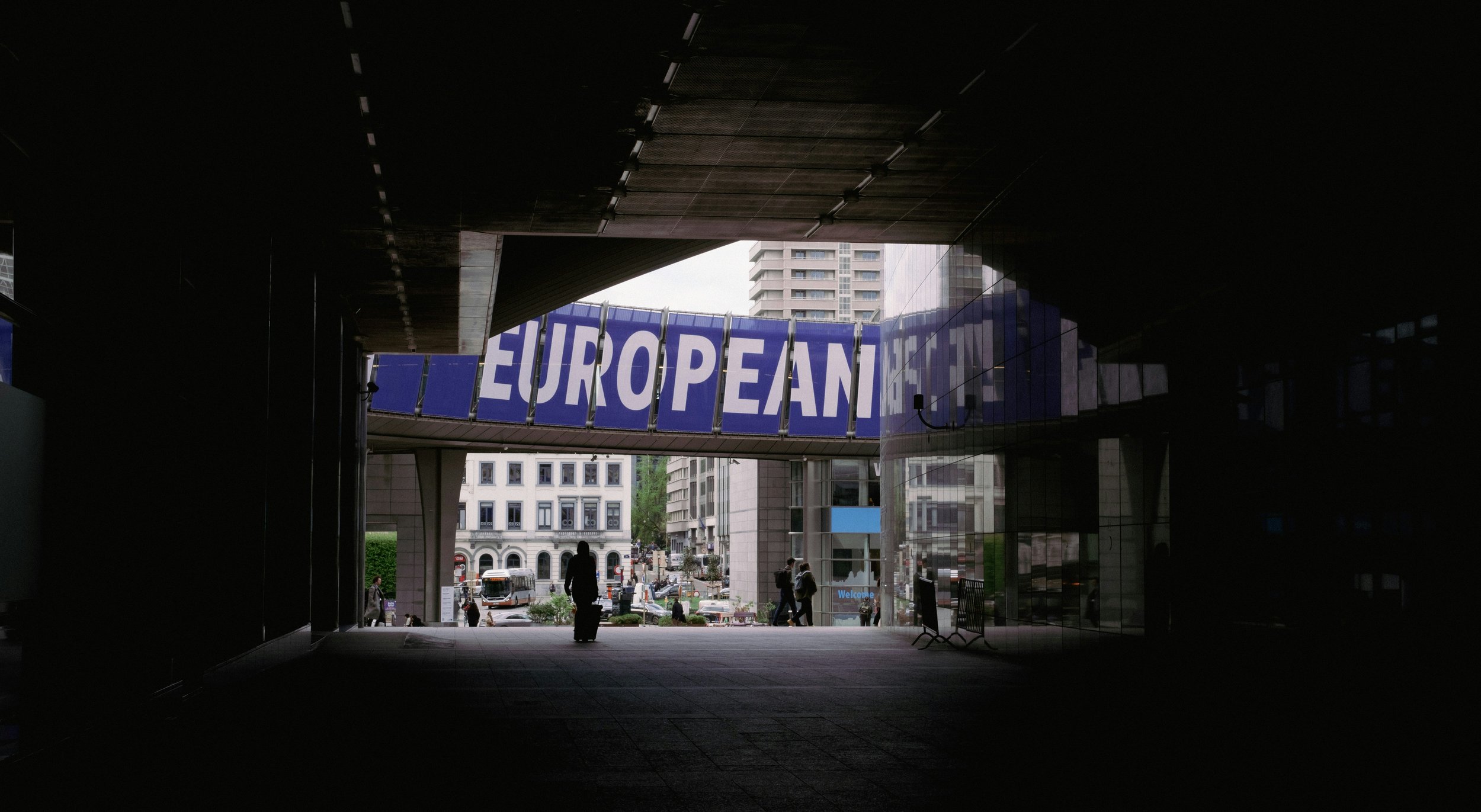
Photo by Ben Garratt
Introduction
At a first glance, the European Union – and the European identity centred on it – might seem like a good example of what belonging without othering might look like. This is certainly how the EU would like to imagine itself. As the European Commission president José Manuel Barroso put it in a speech he gave when the EU was awarded the Nobel Peace Prize in 2012, the post-World War II European project has shown “that it is possible to overcome the differences between ‘them’ and ‘us’” (1). This almost makes it sound as if the EU might be a model for how the Othering and Belonging Institute’s conception of “a bigger ‘we’” can be created (2).
However, there is something surprising about imagining European identity as a kind of model for belonging without othering: historically, European identity has been closely connected to whiteness – a form of belonging that clearly involves othering. Even now, the adjective “white” is usually applied to people who are of European origin – in other words the connection between Europe and whiteness remains. The extent to which a European identity can be seen as a form of belonging that does not involve othering therefore depends on the extent to which a new European identity was created after 1945 that is clearly distinct from older ethnic/cultural ideas of Europe.
This paper examines European identity as an example of supranational belonging and explores its potential as a form of belonging without othering. It examines the history of European identity and the way in which it was transformed in the context of European integration after 1945. It argues that, although European identity is in one sense more inclusive than national identities within Europe, it is in another sense more exclusive. European identity does indeed create a “bigger ‘we’” in the sense that it enlarges the group on which identity centers. But this does not automatically mean that it reduces the role of othering in identity formation. I conclude that the case of Europe suggests that supranational belonging does not tend towards othering any less than national belonging.
Supranational belonging and othering
In Belonging without Othering, john a. powell and Stephen Menendian lay out a framework for thinking about identity formation. They define othering as “a set of dynamics, processes, and structures that, consciously or unconsciously, denies, or fails to accord, full and equal membership in society as well as human dignity on the basis of social group affiliation and identity, and therefore tends to engender marginality and persistent inequality across any of the full range of human differences based on group identities” (5). The challenge is to find ways of creating a sense of belonging that do not involve othering – that is, to create new, broad, inclusive identities.
Towards the end of Belonging without Othering, the authors survey some examples of forms of belonging that begin to take us beyond othering. One such form is the idea of a “rainbow nation”, which we might think of as being the polar opposite of an ethnonation – that is, a nation based on ethnicity, language or religion. Rainbow nations are nations that “have explicitly adopted multicultural, inclusive national identities, and devised institutional supports to structurally ground those identities” (250). Perhaps the best example is post-apartheid South Africa – Nelson Mandela borrowed the term “rainbow nation” from Desmond Tutu and invoked it in his inaugural presidential address.
In addition to such attempts to create an inclusive identity within the borders of an existing nation state, Belonging without Othering also discusses the potential of supranational belonging – that is, attempts to create an inclusive form of identity by going beyond those borders. In particular, the authors are quite optimistic about the EU. While there are also other regional integration projects around the world such as Mercosur and the African Union, the EU is the most developed and is often seen as a model. Thus, the authors see the EU as a “prime example of how a political settlement and institution building can set the stage for a larger, more inclusive ‘we’” (257) and argue that it has “reconfigured identity in a more inclusive way” (258).
The question is whether European identity really does offer this new, more inclusive form of identity that the authors of Belonging without Othering suggest it does. In particular, can a European identity function as a kind of “bridging” identity or a way of bringing “people who are ‘othered’ or currently outside of our identity group” into “our sphere of concern” (191)? By bringing together national identities within Europe, “European” certainly creates “a bigger ‘we’”. In that sense, at least, it may be an identity that is broader and more inclusive than national identities in Europe. But although it may include more people, is European identity really more “porous” and “fluid” (207) than national identities?
There is also another possibility. Although European identity may bring Europeans together and reduce the othering that was involved in the creation of national identities within Europe, this process may itself involve the othering of non-Europeans. In other words, although European identity may be inclusive in one sense, it may be exclusive in another sense. To use the language of the belongingness paradigm, it may be that European identity formation involves “bonding” (that is, “when members of a group turn inward, and focus mainly on each other and themselves”) or even “breaking” (that is, “where members of a group not only turn inward, but explicitly push members of other groups away”). (176)
European identities
Although some like to imagine that European identity is an expression of cosmopolitanism, I have argued that it is more helpful to think of European identity in terms of regionalism – that is, as something that is analogous to nationalism but on a larger, continental scale (3). Like national identities, regional identities can, and generally do, include both ethnic/cultural and civic elements – a distinction that goes back to Hans Kohn’s early study of nationalism (4). Historically, European identity has clearly included ethnic/cultural elements: during the medieval period, it was largely synonymous with Christianity; in the modern period, it was intimately connected to whiteness.
The distinction between ethnic/cultural and civic elements of identity maps quite neatly onto the belongingness paradigm: we can think of identities in which ethnic/cultural elements are dominant as forms of belonging that other, and identities in which civic elements are dominant as forms of belonging without othering (or at least a minimal degree of othering). Thus another way of saying that, historically, European identity has included ethnic/cultural as well as civic elements is that it has clearly involved othering. In this sense, European identity was formed in a similar way to national identities in Europe, which also involved ethnic/cultural as well as civic elements.
However, whereas national identities in Europe were defined to a large extent in opposition to each other – that is, their others were other Europeans – European identity formed in opposition to multiple non-European others. During the medieval period, when Europe was largely synonymous with Christianity, Jews were its primary internal other and Islam was its primary external other. From the Enlightenment onwards, and especially in the colonial era, non-white people around the world became Europe’s “constitutive outside”. In the twentieth century, Europe was also increasingly defined against, and seen as being in competition with, Russia and the United States.
The crucial question is what happened to European identity after 1945. Many supporters of European integration like to believe that 1945 was a kind of “zero hour” and that a new, purely civic identity emerged, centred on what became the EU. Thus they imagine that the beginning of European integration as a kind of clean break with the continent’s dark history—and that the only othering it involved was of Europe’s own past (5). But this view overlooks the continuities in ideas of Europe. In reality, the ethnic/cultural elements of European identity persisted after 1945 and influenced the European project itself. Europe did not simply stop othering after World War II.
It is true that, in the context of European integration, a new, more civic idea of Europe emerged, which was centered on the social market economy and the welfare state (in other words a socio-economic model) and the depoliticised mode of governance that, beginning with the European Coal and Steel Community, integration had produced (in other words a political model). But as the longtime European Commission president Jacques Delors admitted in the 1980s: “You cannot fall in love with the single market” (6). In order to give the project legitimacy and pathos, European leaders also drew on older ethnic/cultural elements–for example the figure of Charlemagne, the embodiment of the medieval idea of Europe that was synonymous with Christianity, who became a kind of inspiration for the EU.
As World War II receded into history and it became less convincing to claim that European integration was all that stood between Europeans and war, the need for sources of legitimacy to justify further integration became even more acute. This led to a conscious project of “building Europe,” driven by “pro-European” elites, which was somewhat similar to nineteenth-century nation building–and in which culture was central. As the anthropologist Cris Shore puts in a study of this project of “building Europe:” “The politicisation of culture in the EU arises from the attempt by European elites to solve the EU’s chronic problems of legitimacy” (7).
European stories
The authors of Belonging without Othering emphasize the importance of stories in creating new, more inclusive identities. “Narrative is one of the principal ways we construct a sense of belonging today, just as it has been for millennia,” they write (235). But whereas some stories are “exclusionary and preclude a large, belonging ‘we’” (235), others can “advance a more inclusive belonging vision for society” (230). The difference between these two different kinds of stories has to do with the role of othering in them. In particular, inclusive stories do not include a strong in-group and out-group: “An effective belonging story must provide dignity and a future for all people.” (235).
In the case of Europe, the reality is again more problematic than it might at first appear. Central to the story that supporters of the EU like to tell is that Europe has learned the lessons from its history: after centuries of conflict between them, culminating in World War II and the Holocaust, Europeans have united to create a better future. This is the idea of the EU as a “peace project,” which began with the famous declaration made by French Foreign Minister Robert Schuman in 1950 that France and Germany had resolved to pool coal and steel production in order to make war between France and Germany “not merely unthinkable, but materially impossible” (8).
However, when Schuman made his declaration, France was fighting a brutal colonial war in Indochina. Similarly, when the Treaty of Rome was signed in 1957–the next major step in European integration, which created the European Economic Community–France was fighting another brutal colonial war, this time in Algeria (and another in Cameroon). Even in the post-Cold War period, Europeans have been quite willing to deploy military force, and they have done so much more than, say, China. Yet, they continue to imagine that they are uniquely peaceful. In reality, in other words, European states never rejected war in general after World War II, as they often claim, but only war with each other.
In so far as the EU stands for peace, it seems to me that, drawing on Tyler Stovall’s idea of “white freedom,” we can think of it as a “white peace”–that is, peace with other Europeans rather than with the rest of the world (9). Moreover, the reason that many supporters of European integration were so passionate in rejecting war with each other was that it was weakening European domination over the rest of the world and especially its colonies. The EU’s founding fathers were not against colonialism as such but only against its competitive element. In fact, part of the thinking behind the idea of European integration in its early phase in 1950s was that it would allow western European powers to consolidate–or integrate–their colonies (10).
However, the origins of European integration as a colonial project have been written out of the story that the EU tells about itself. The official narrative of the EU is based on the internal lessons of European history–that is, what Europeans did to each other. From the 1980s onwards, this story of conflict between Europeans increasingly incorporated the Holocaust, which could be easily integrated into the narrative of the internal lessons of European history, not least because the Holocaust took place in the context of World War II. But the official narrative of the EU never included the external lessons of European history–that is, what Europeans had done to the rest of the world, in particular colonialism.
It is not a coincidence that the history of colonialism was occluded in this way in the context of European integration. European integration structurally encourages Europeans to think of their history in terms of their interactions with each other rather than the interactions of Europeans with the rest of the world and thus to think of Europe as a “closed system” – in other words, a region that has its own self-contained history that is separate from that of other regions. This erases deep interconnections with other histories – both the multiple external influences on Europe, in particular from Africa and the Middle East, and the interactions of Europeans with the rest of the world beyond the contested and shifting geographical boundaries of Europe (11).
The rise of the far right and the transformation of the EU
During the last decade since the refugee crisis in 2015, the ethnic and cultural elements of European identity seem to have become more dominant relative to the civic elements than they previously were. This has taken place against the background of the rise of the far right throughout Europe, which has put centrist leaders under increasing pressure. In response, they have increasingly mainstreamed and normalized far-right ideas, especially around identity, immigration and Islam (12). In this context, the distinction between “liberal” pro-Europeans and “illiberal” Eurosceptics has dissolved as the EU is increasingly remade in the image of the far right.
The European far right is often imagined as being inherently nationalist and therefore incompatible with a post-nationalist EU–many thought that all it could do was to disrupt the functioning of the EU and prevent further integration or, if they were to become strong enough, break up the EU. For much of the last decade, the paradigmatic European far-right figure was Hungarian prime minister Viktor Orbán, who, even as he remained part of the European People’s Party, the centre-right grouping in the European Parliament, clashed with German chancellor Angela Merkel and with leaders of the EU institutions like European Commission President Ursula von der Leyen.
Today, however, the paradigmatic European far-right figure is Giorgia Meloni, who became Italian prime minister in 2022. Although she leads a party, Fratelli d’Italia, whose history goes back to the original Italian fascist party and is a member of the European Conservatives and Reformists (ECR), a far-right grouping in the European Parliament, she has a much more harmonious relationship with the EU than Orbán. Whereas von der Leyen clashed with Orbán over refugee policy, she has cooperated with Meloni. Together, they negotiated an EU refugee deal with Tunisia in 2023, which made the EU complicit in human rights abuses against asylum seekers (13).
What these developments illustrate is that the far right and the EU are more compatible than was long imagined. On the one hand, the mistaken belief that they were incompatible was based on an idealization of the EU as an inherently progressive project–in reality, even after 1945, European identity always included ethnic/cultural elements. On the other hand, it was based on a simplification of the thinking of the European far right–in reality, they are not just nationalists but also civilizationalists (14). In particular, the far right imagines Europe as a civilization that is threatened. But centrists have also used similar language–for example, French president Emmanuel Macron has said that European civilization is in “mortal danger” (15).
What I have elsewhere called the civilizational turn in the European project operates most clearly in the hardening of EU refugee policy during the last decade. But it is not just the brutality of the EU’s policies, which have led to over 30,000 deaths in the Mediterranean during the last decade–around five times as many as at the southern border of the United States in the same period (16). It is also the way in which EU refugee policy has been framed–and what this tells us about the way that European identity is increasingly being imagined. For example, when von der Leyen became European Commission president in 2019, she created a new position of Commissioner for Promoting Our European Way of Life, which included responsibility for migration (17).
During an earlier phase in the European project, the phrase “European way of life” had been used to capture the EU’s socio-economic model, and in particular the principle of solidarity it expressed–in other words it suggested a more civic idea of Europe. In 2001, for example, the socialist French prime minister Lionel Jospin had spoken of a specific European way of life based on this model (18). But the connection of the phrase with migration made it clear that the EU now understood the “European way of life” in a much more ethnic/cultural way. The title of the new position made it explicit that migration was not just as a difficult issue to be managed but a threat to the “European way of life”.
Ethnonationalism and ethnoregionalism
What looking at the case of Europe shows is that a bigger “we” is not automatically a more inclusive one. The size of the group or unit and the degree of othering are two quite separate things – and enlarging the group or unit does not necessarily mean reducing othering. A regional identity is not necessarily more “porous” and “fluid” than a national identity. In Belonging without Othering, powell and Menendian rightly point out the dangers of ethnonationalism. But the example of Europe suggests that moving beyond the nation state to a form of supranational identity does not automatically reduce the salience of ethnic/cultural forms of belonging. Rather, it may simply replace ethnonationalism with ethnoregionalism.
Of course, this is not to suggest that belonging without othering cannot exist in a supranational context. The evolution of the meaning of the phrase “European way of life” suggests that the ethnic/cultural elements of European identity are displacing the civic ones. But it is also possible to imagine a different Europe in which the opposite would happen–that is, a progression towards a more civic identity. Moreover, identity formation–and especially how ethnic/cultural and civic elements interact with each other–may be quite different in other regional integration projects around the world than in Europe (19). But supranational identities are not inherently more able than national identities to find a form of belonging without othering.
References:
European Union Nobel Lecture, Oslo, 10 December 2012, https://www.nobelprize.org/prizes/peace/2012/eu/lecture/.
I take as the main reference point for this conception, john a. powell and Stephen Menendian, Belonging without Othering. How We Save Ourselves and the World (Stanford: Stanford University Press, 2024). Hereafter page references are given in brackets in the main body of the text.
See Hans Kundnani, Eurowhiteness. Culture, Empire and Race in the European Project (London: Hurst, 2023).
See Hans Kohn, The Idea of Nationalism: A Study in Its Origins and Background (London: Macmillan, 1944).
See for example Mark Leonard, “The meaning of pro-Europeanism – a response to Hans Kundnani”, New Statesman, 22 February 2021, https://www.newstatesman.com/world/2021/02/meaning-pro-europeanism-response-hans-kundnani. The formulation was originally used by the Danish international relations theorist Ole Wæver in relation to the EU’s understanding of security. See Ole Wæver, “European Security Identities”, Journal of Common Market Studies, Vol. 34, No. 1, March 1996, pp. 103-132, here p. 122.
Jacques Delors, Statesment on the broad lines of Commission policy, 17 January 1989, https://op.europa.eu/en/publication-detail/-/publication/59acf3b9-04e2-4dc2-a031-dd1b7e9c6c32.
See Cris Shore, Building Europe. The Cultural Politics of European Integration (London: Routledge, 2013).
Schuman Declaration, 9 May 1950, https://european-union.europa.eu/principles-countries-history/history-eu/1945-59/schuman-declaration-may-1950_en.
Tyler Stovall, White Freedom. The Racial History of an Idea (Princeton: Princeton University Press, 2021).
See Peo Hansen/Stefan Jonsson, Eurafrica. The Untold Story of European Integration and Colonialism (London: Bloomsbury, 2014).
As Stuart Hall puts it, Europe tends to “disavow its historic instability and its deep interconnections with other histories.” Stuart Hall, “‘In but Not of Europe’: Europe and its myths”, Soundings 22, Winter, 2002-03, pp. 57–69, here p. 61, https://journals.lwbooks.co.uk/soundings/vol-2002-issue-22/article-6929/.
See Cas Mudde, The Far Right Today (Cambridge: Polity: 2019).
See Amnesty International, “EU/Tunisia: Agreement on migration ‘makes EU complicit’ in abuses against asylum seekers, refugees and migrants”, 17 July 2023, https://www.amnesty.org/en/latest/news/2023/07/eu-tunisia-agreement-on-migration-makes-eu-complicit-in-abuses-against-asylum-seekers-refugees-and-migrants/.
Rogers Brubaker, “Between nationalism and civilizationism: the European populist moment in comparative perspective”, Ethnic and Racial Studies, 40:8, 2017, pp. 1191-1226.
“Emmanuel Macron’s urgent message for Europe”, Economist, 2 May 2024, https://www.economist.com/leaders/2024/05/02/emmanuel-macrons-urgent-message-for-europe. Whereas the far right tends to emphasize the threat from non-white immigration and especially Muslim immigration, centrists like Macron tends to emphasize the threat from foreign powers.
See the data from the International Organization for Migration’s Missing Migrants Project, https://missingmigrants.iom.int/data.
See Matina Stevis-Gridneff, “‘Protecting Our European Way of Life’? Outrage Follows New E.U. Role”, New York Times, 12 September 2019, https://www.nytimes.com/2019/09/12/world/europe/eu-ursula-von-der-leyen-migration.html.
Speech by Lionel Jospin on “The Future of an Enlarged Europe” 28 May 2001.
On ideas for African and Caribbean federations after decolonization, see Worldmaking after Empire. The Rise and Fall of Self-Determination (Princeton/Oxford: Princeton University Press, 2019). Getachew argues that the European case should not be seen as paradigmatic: “Attending to the specificity of postcolonial federation highlights how the anticolonial preoccupation with economic dependence gave postcolonial federation a distinctive orientation.” (139)
Author bio:
Hans Kundnani is a senior fellow at the Othering & Belonging Institute, an Open Society Ideas Workshop fellow, and a visiting professor in practice at the London School of Economics.
He was previously the director of the Europe programme at the Royal Institute of International Affairs (Chatham House), a senior Transatlantic fellow at the German Marshall Fund of the United States, and research director at the European Council on Foreign Relations. He has also been a visiting fellow at the Remarque Institute at New York University, the New School, and Göttingen University. He has taught at Boston University, New York University and the Collège d’Europe.
Hans is the author of three books: Eurowhiteness. Culture, Empire and Race in the European Project (London: Hurst, 2023); The Paradox of German Power (London/New York: Hurst/Oxford University Press, 2014), which has been translated into German, Italian, Japanese, Korean and Spanish; and Utopia or Auschwitz. Germany’s 1968 Generation and the Holocaust (London/New York: Hurst/Columbia University Press, 2009).
Hans is a columnist for the New Statesman and also writes for other publications such as Dissent, the Times Literary Supplement, Foreign Affairs and Internationale Politik. He studied German and philosophy at Oxford University and journalism at Columbia University in New York, where he was a Fulbright Scholar.
Editor's note: The ideas expressed in this blog are not necessarily those of the Othering & Belonging Institute or UC Berkeley, but belong to the authors.