Lies, Propaganda, and Culture: “Truthtellers” in the Authoritarian Populist Era
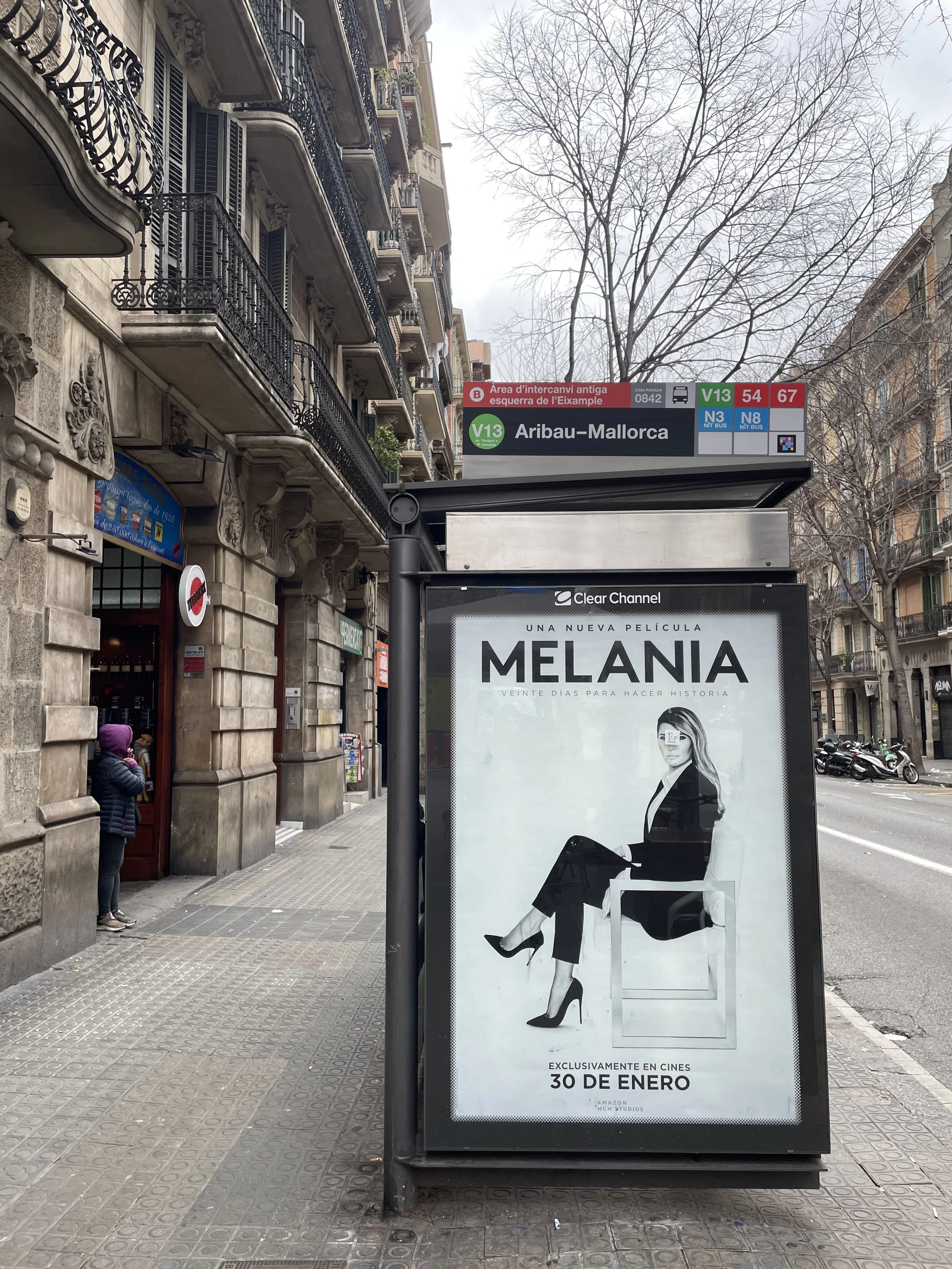
Photo by Míriam Juan-Torres González
One could make people believe the most fantastic statements one day, and trust that if the next day they were given irrefutable proof of their falsehood, they would take refuge in cynicism; instead of deserting the leaders who had lied to them, they would protest that they had known all along that the statement was a lie and would admire the leaders for their superior tactical cleverness.
- Hannah Arendt, The Origins of Totalitarianism
Propaganda, Lies, and Media in the Authoritarian Populist Era
I was walking around Barcelona when Melania Trump’s gaze suddenly greeted me on the side of a bus shelter. Disoriented by the sight of the US first lady in the heart of Catalonia, I moved closer and realized it was an ad for her documentary. I had seen coverage of the movie premiere throughout the week, most articles presaging what a flop the documentary would be. Then came the opening weekend (strongest documentary debut in a decade)–and the reviews. At the time of this writing, the documentary has a staggering gap between critic and audience reviews (at 10 percent vs 99 percent respectively) on Rotten Tomatoes.
In a way, the coverage of Melania the documentary encapsulates and mirrors much that is true about modern day authoritarian populist politics: It speaks to a reality of polarization, of irreconcilable perceptions, of lies and propaganda.
The role of lies in politics is not unique to our times nor can it be reduced to a specific party or ideology. One needs only remember the “weapons of mass destruction” line used to justify the Iraq war in the early aughts. Having grown up in Spain, corruption-related lies have also been our bread and butter (from across the political spectrum).
But lies, nowadays, especially amongst wannabe authoritarian or illiberal leaders, seem to take on a different tone. They are constant, overt, unabashed, with little effort to cover that they are, indeed, lies. How overt lies can be received so nonchalantly amongst some segments of society can be explained by many factors: partly, by the functions lies serve in terms of signalling and shaping a leader’s image; partly, by how they fit seamlessly within a public discourse and media ecosystem that is characterized by skepticism and anti-establishment sentiment and which self-fashions as truth-seeking and subversive.
The Role of Lies in Authoritarian Populist Politics
Back in 2016, blatant lies came into the spotlight when the UK's Vote Leave (Brexit) campaign emblazoned a bus with the slogan "We send the EU £350 million a week— let's fund our NHS instead," promoting widely inaccurate and misconstrued numbers. But in the decade since, Donald Trump and his allies have made a perverse art form out of blatant lying and undeniably normalized the practice. Indeed, in its second term, the Trump administration's lies brazenly defy observers to trust their own eyes: claiming to have resolved 8 wars in 10 months, asserting that egg prices have dropped 82 percent, or—most disturbingly—having US government officials reinterpret video footage of Alex Pretti holding a phone as him brandishing a gun.
Whether it’s Trump, Farage, Hungary’s Viktor Orbán, France’s Marine Le Pen, Italy’s Giorgia Meloni, or someone else in their ecosystem, authoritarian populists have made the blatant lie a commonly wielded tool in their toolbelt. They all have had predecessors in this style of lying, men who have been the subject of some scholarly analysis on the role lies play in this kind of politics. Former Italian prime minister Silvio Berlusconi and former French presidential candidate Jean-Marie Le Pen (father of Marine Le Pen) are two earlier authoritarian populist leaders who have heavily influenced our current political landscape. In her book Populocracy, scholar Catherine Fieschi writes that Le Pen the father was not the first to lie, but he did effectively utilize lying as a strategic tool to send a signal and demonstrate "a willingness to do anything to advance the cause of one’s people, or to signal that one is entirely above the establishment’s conventions, or even to show one’s flawed humanity and a relaxed attitude toward these natural, human failings." She continues: "Lying as a demonstration of one’s irrepressibly authentic nature: what could be more sincere than that?”
Scholar Ruth Ben-Ghiat adds that “Authoritarian leaders believe they are above the law, and they also believe that they are above the truth in that they reserve the right to determine what is truth and what is fiction. Just as they transform the rule of law into rule by the lawless, so do they make lies into party and state doctrine.”
Other scholars have shown how in authoritarian regimes, lies and authoritarian propaganda work by shaping the cognitive environment, not to convince of the lies, but to reshape how things are perceived, suppress alternatives, and limit hope (for the Kremlin’s strategic use of lies see this article; i.e., the Kremlin lies for several strategic purposes: to deflect blame for exposed wrongdoing, to project brazenness and intimidation both domestically and internationally, to troll Western elites for perceived hypocrisy, and to signal underlying bargaining positions where the lie itself points to what Moscow actually wants in exchange for stopping certain behaviors.).
In sum, lying is useful to signal determination, to sow distrust while displaying “authenticity,” and to cement anti-establishment cred—all of which decisively speak to the defining features of our current public, political, and media lives.
The Perfect Climate for Political Lies
Our times are defined by anti-establishment sentiment and discontent. This was clear in 2024, when incumbent after incumbent was defeated in elections. Polls continuously reveal people’s discontent with politics and a pervasive lack of faith in the system. To be fair, the discontent is valid. I myself have struggled at times when undertaking public opinion research and speaking of the problem of a lack of trust in public institutions. As a Spaniard, it is hard for me to argue for trust in public institutions that time after time have been led by people engaged in high-level corruption. Is it a problem of trust, or untrustworthiness?
Yet the mistrust and understandable anti-establishment sentiment is often interpreted in favor of leaders and movements who are authoritarian, profit driven, and who use lies not only to cover up wrongdoing, but as Fieschi argues, as “an instrument of subversion.” When lies signal commitment to fighting a corrupt system, they become acceptable tools for destroying it. In this twisted logic, lying can even make someone seem more authentic and human. Authenticity becomes tied to subversion, even when what's being subverted is truth itself.
Our media ecosystem doesn't just reflect this dynamic—it actively facilitates the conversion of legitimate discontent into support for authoritarian leaders. Legacy media's business models often prioritize conflict and engagement over accountability, while social media platforms amplify conspiracy theories and reward provocateurs. Together, they enable the conditions where lies are celebrated as acts of defiance and outrageous claims gain the most traction. This matters even more as social media and video become the primary sources of information worldwide—especially in Latin America, Africa, and Southeast Asia, and now in the United States as well. The shift from grievance to authoritarianism isn't inevitable; it's empowered by systems that profit from outrage at the expense of rigor and supporting journalists committed to proper reporting and high standards.
Supposedly, the main currency for social media success is “authenticity.” Authenticity, obviously, is performed, but amongst politically engaged influencers (be it on Twitter, other platforms, or podcasts), it is often the case that authenticity is performed through provocation and a supposed attempt at uncovering an elusive, and typically nefariously hidden, “truth.” This has evolved into a cottage industry of opinionated “apolitical” or “beyond left-right” commentators (in their words) and professional provocateurs.
As writer John Ganz describes them, “The main feature tying together the shows that young right-leaning men watch and listen to now is curiosity: They include discussions and debates; their hosts might not be particularly knowledgeable and they are open about it, so they ask what might seem like dumb questions without shame. Even when the discussion veers into pure propaganda, it comes wrapped in the appearance of open inquiry.”
It is not a lie if it is followed by a question mark. But the idea has been planted. The style is enunciative, confident, "just asking questions," coupled with calculated transgressions. Especially notable are transgressions aimed against experts, which is to say, “the experts” in sardonic scare quotes, according to those performing authentic free inquiry. And just like that, the lies or mistaken ideas (with question marks!) run wild while the person who shared or believes them can feel savvy—cynical and open to transgressive ideas becomes a mark of being perceptive (or red pilled or black pilled, in online parlance). You are someone who sees what others don't and who can't be fooled, even as you accept the truth of something absurd. It helps, of course, that this style has proven lucrative for many podcasters, particularly those whose transgressive commentary and pseudo-scientific interviews generate the most engagement.
No one exemplifies this better than Joe Rogan, whose podcast tops the charts not only in the US, but also in the United Kingdom and Australia. Rogan and similar “question asking truthtellers” fertilize the soil that helps blatant lies become palatable–even if they cannot be uniquely held responsible.
Social media has brought about a new, complex, and decentralized media ecosystem which presents opportunities for wannabe-authoritarians: it facilitates the unique mixture of gullibility and cynicism that Hannah Arendt identified in The Origins of Totalitarianism as key conditions for propaganda and indoctrination. “In an ever-changing, incomprehensible world, the masses had reached the point where they would, at the same time, believe everything and nothing, think that everything was possible and that nothing was true,” she wrote. “Mass propaganda discovered that its audience was ready at all times to believe the worst, no matter how absurd, and did not particularly object to being deceived because it held every statement to be a lie anyhow.”
Systemic Vulnerabilities: Where the Model May Break Down
The landscape looks grim, but authoritarian populist consolidation through media control faces inherent contradictions, vulnerabilities that point to where resistance can take hold.
Authoritarian populist leaders understand that a tight grip on the media ecosystem is key to consolidation. Hungary's Orbán knows this well, having created a pro-government media empire that dominates the country; Slovakia’s Robert Fico is trying to follow suit. Yet full-on media capture remains difficult in countries with extensive networks of independent outlets, such as the US or the UK. Even where governments push hard through legislative constraints, harassment, and censorship, as in Hungary, quality independent journalism continues to exist as "a cohort of outlets maintain a strong commitment to fact-based, public interest reporting. This is reinforced by high levels of public support, which has translated to significant subscription funding and solidarity when an outlet is targeted."
Legacy media is under-resourced and often increasingly owned by techno-oligarchs allied with the regime. Yet even when big corporations bend the knee, we see people and outlets that refuse. A small but telling example: Shortly after the US election, Condé Nast closed Teen Vogue, its most progressive and politically-sophisticated magazine. Nonetheless, Vanity Fair picked up the mantle and published one of the most compelling pieces of journalism on the Trump administration in years, heavily reported and fact-based. Even if traditional media fails to attract the same large numbers, cultural messaging from legacy institutions remains significant.
More critically, the very ecosystem that enables authoritarian populist lies—the decentralized, profit-driven world of podcasters and influencers—is also fundamentally unstable. If so much relies on uncontrollable grifters, this could easily turn against authoritarians. When these allies turn full-blown Nazi or conspiracists (or both), as is happening with Nick Fuentes, Candace Owens, Tucker Carlson, or Andrew Tate, they become liabilities if the public still has red lines (it also makes the authoritarian populist coalition more fragile, as they increasingly turn against each other).
And when the point is the bottom line and egos, allegiance becomes fickle. While many of the best-performing podcasters are allied with far-right politicians, nothing prevents them from turning their backs if it's more profitable or if they believe political leaders are going too far (or not far enough).
Finally, demand itself shifts. There may be an appetite now for the transgressive provocateur who bolsters far-right politicians, but if history is a good indicator, this trend too will pass. What comes next may be worse, better, or different—but that is something that can be shaped.
The question isn't whether we can eliminate lies from politics—we can't. The question is whether we can rebuild the conditions where truth still matters, where cynicism doesn't masquerade as sophistication, and where accountability has teeth. As Arendt understood, the unique mixture of gullibility and cynicism that makes propaganda effective isn't permanent—it's cultivated. Which means it can also be disrupted. What contributes to a climate where lies are no longer acceptable is not inevitable; it must be built.
And for the soul…
Roal Dahl’s writing hut and process
While traditional media continues to struggle and be the target of authoritarian / oligarch takeover, I find hope amongst independent magazines, which seem to be thriving. I love Apartamento, which is a balm for the soul. I read it slowly over the weeks. Do you have any favorites? I would love recommendations!
Connecting the Dots: Musings on Bridging and Belonging is a monthly column by Míriam Juan-Torres. In it, Míriam reflects on current events, connecting the trends and considering the specificities across countries, applying a bridging and belonging lens and translating concepts from academia for a wider audience. Join our mailing list to stay up to date on the latest of the Democracy & Belonging Forum's curated analysis from Miriam and more.
Editor's note: The ideas expressed in this blog are not necessarily those of the Othering & Belonging Institute or UC Berkeley, but belong to the authors.