Following the signing of the 1998 Good Friday Agreement, Northern Ireland has routinely been held up as a successful peace process. The Agreement largely ended three decades of violence involving Irish nationalist groups, drawn largely from the Catholic community, British unionist groups, drawn largely from the Protestant community, and the British state. But the reality is more complex. This past summer was the third in a row in which racist riots broke out across the region, following a stabbing for which a Sudanese asylum seeker was charged. Weeks later, another standoff unfolded in the town of Portadown after a court allowed a parade by a Protestant loyal order through a nationalist area for the first time in 28 years.
To make sense of these fault lines, both long-standing and newly emerging, the Democracy & Belonging Forum's Sara Grossman-Kersting spoke with three leaders in the region working to build belonging in their communities.
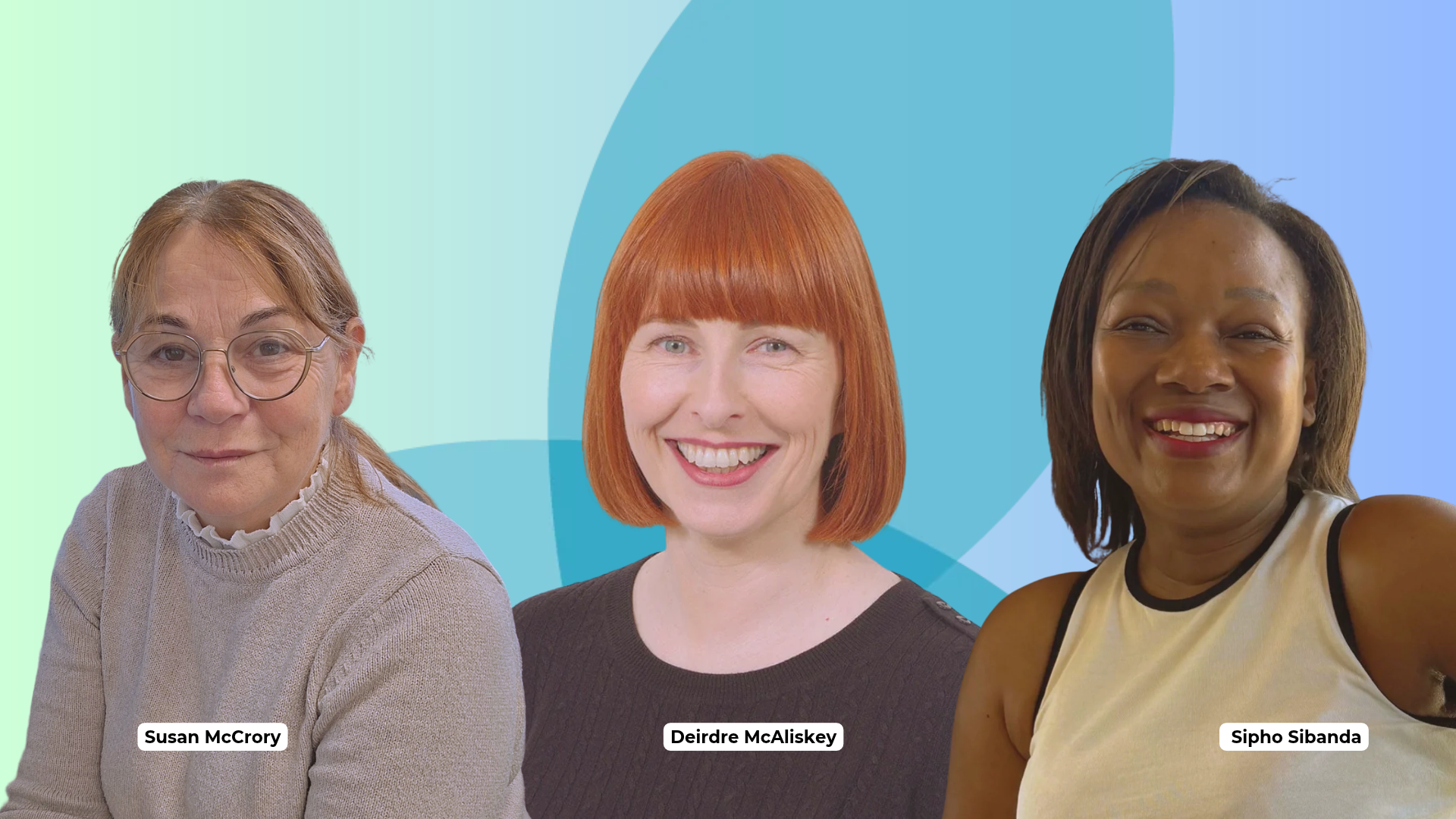
Susan McCrory has run the Falls Women's Centre in West Belfast since the early 1990s. Deirdre McAliskey works on policy and practice at the South Tyrone Empowerment Programme in Dungannon, and previously worked at the Northern Ireland Human Rights Commission. Sipho Sibanda came to Northern Ireland from Zimbabwe in 2015 and convenes Black Activist Leadership, part of the Social Change Initiative.
They discussed why a peace agreement built to stop the violence and share power between two communities has not addressed what produced the conflict, why that framework struggles to hold an increasingly diverse population, and why all three see human rights as a precondition for peacebuilding.
To start, how does each of you describe the work you do and what brought you to it? And do you see your work as fundamentally about building and maintaining peace in your community?
Deirdre McAliskey: I started in Irish language community development, then worked in the victims sector with families affected by conflict-related violence, then in the women's sector alongside Susan. My work has centered on children and families, and more recently on racial equality and children in the asylum system. I'm in a rural setting now, where the issues are poverty, racism, and the exclusion of people whose lives are treated as too complex or messy.
I don't know that I ever consciously looked at any of my work as peacebuilding. For a long time you're doing something because it needs to be done and because you can't watch it not be done. I've also done very little ‘Catholic and Protestant’ conflict-resolution work. My framework has always been human rights, which means trying to repair the balance of power between rights holders and duty bearers, which is the state. In practice that looks ordinary. An ESOL cafe where someone can find a social space and pick up a friend, begin to believe that they are entitled to more, by right. Honest conversations about power and privilege.
A lot of that comes from growing up in a community seriously affected by conflict. The conflict was entirely pervasive, and I experienced a lot of fear in my childhood. I was a very small child when there was an assassination attempt on my parents, so I saw early who is protected by rights and who is left vulnerable to state violence.
Sipho Sibanda: I have always considered myself an activist. It’s in my blood. Day to day the work looks ordinary. Listening to people, building trust, helping solve practical problems. You have to be creative too. If someone can’t come because of a lack of food or childcare, you build that into the program. And you can’t do it if your heart isn’t in it. It’s long days and nights, and most of it is unpaid.
I grew up in Bulawayo, Zimbabwe, and coming from Matabeleland, the history and legacy of the Matabeleland Massacres is something I cannot separate from how I understand conflict and its aftermath. Its impact goes beyond the lives that were lost. It lives on in families, in the silence around what happened, and in stories that have never been given space to be heard. People learn to live with pain without ever having the opportunity to heal.
Zimbabwe and Northern Ireland have very different histories. But one thing Zimbabwe taught me is that you cannot assume a society has healed simply because life has moved on. What looks like peace on the surface can hide pain, mistrust and unresolved questions underneath. You cannot ask people to move on from something they have never been given the opportunity to acknowledge.
So if I were to say what growing up in Zimbabwe taught me about Belfast that people who have only known Belfast might not see, it would be this: peace is more than the absence of violence. It is about whether people feel seen, whether their pain is acknowledged, and whether they feel they belong.
Susan McCrory: My work is with women and community development, and I have never worked anywhere but my own community. Falls Women's Centre has always worked across the Protestant-Catholic divide. Even at the height of the Troubles we were women working together on women's issues, which in itself is political. In the early days we used the city center as neutral ground. Now women from the Shankill come over to us on their own to enroll in programs and we do a lot of cross-border work with groups in other areas.
From my perspective, you can't separate human rights and peacebuilding. If you haven't got human rights, you don't have peace.
All of your work happens in a place organised around one longstanding divide, between Catholics and Protestants. In June, the violence was aimed somewhere else, as racist and anti-immigrant riots broke out across Northern Ireland. What were those weeks like for you and how has the community come together since then?
Susan: In June it was armed men going down streets, kicking in doors, burning houses. It retraumatized a lot of people in my area, and what happened to them in '69, '70, '71. At the Centre we just started working with whoever came. Could anyone give a lift? Can someone pick someone up? You kicked into action without thinking, which is what we have done for 50 years. It hasn't left us.
But we haven't been able to sit back and reflect on June, to talk about it, to understand the trauma and then look at how we prevent it. Because when this settles, and it will settle, there will be another one.
Sipho: Susan is right that what happened in June hasn't left us. There was a vulnerability uncovered then, and it's been left like an open sore that was never covered. Seeing people being blatantly racist was a shock to my community. People didn't think it could happen, and it happened overnight. And it wasn't the first time.
There was solidarity too. People went door to door, are you okay, here's some food. But people were afraid to go out. They kept their children home from school. Some left Northern Ireland and never came back.
Just this past weekend we had a community lunch, over 60 people. One man made a joke. He said: "We're getting a break while attention is on Portadown. Our community can get a breather, because when that finishes we know they're coming back for us." Hearing that was frightening, because even said lightly, it was the truth. It's like walking on eggshells.
Does what happened amount to a new divide here, between people who are from here, whether Catholic or Protestant, and people who are not?
Sipho: It is a new divide, in some ways. As long as you are non-white, they see you as not British and not Irish, no matter how many generations your family has been here.
But unrest and racism are being pushed by the same people who push any kind of othering, and sectarianism is still there underneath it. Newcomer communities walk into a situation where something is already going on, and often people have no idea what it is. When I came here it took me taking a personal interest to learn the history, the flags, the context. People need to be briefed on the land they are walking into. But that's a lot to ask, because people arrive carrying their own trauma from their home countries.
Deirdre: We have seen Union Jacks and Irish tricolors brought together by racists of both creeds protesting immigration. But it's not one divide displacing the other. It's one building on and leading to the other. Racism and sectarianism come from the same belief, that we are not all born free, equal, inherent in dignity and rights simply by virtue of being born. Power protects itself. For someone to be at the top, another must be at the bottom.
Everything about our institutions was built on othering, to create and maintain power imbalances. You walk into the Assembly and you must register as nationalist, unionist or other. The problem now is that the category "other" has become diverse. Originally designed to allow for—but give no real political power to—the small number of elected representatives who held no firm position on the constitutional future of the six counties or Northern Ireland, the designation of ‘other’ is now an attractive one for progressives of all shades who are seeking reform. As our communities diversify to include people born elsewhere, and we have more independents and small parties who want rights, good housing, and healthcare for all, the constitutional question takes second place. But because conversations about rights and poverty aren't happening structurally, politicians weaponize sectarianism and racism because those old divides on who won and who lost still pull votes.
Susan: As it stands at the moment, I don't see much difference between nationalist and loyalist sectarianism and racism. The sectarianism I grew up in and lived through feels the same as the racism going on here today. The only difference is that I was born and raised here, so I know the community, whereas new people coming in have to learn to adjust.
It sounds like all of you are predicting another outbreak of violence, whether triggered by disagreements around immigration, Northern Irish identity, or reunification. To all of you: Why has the Good Friday Agreement failed to end identity-based conflict in the region?
Deirdre: I didn't vote for the Good Friday Agreement. I never believed it would end the conflict, because it was never designed to deal with what caused the conflict. It was a peace deal. It stopped the violence, it shared power between two blocs, and it left everything underneath exactly as it was. In 28 years nobody has been required to go back and look at any of that. We’re now seeing the biggest collapse of the peace project in a very long time.
Susan: Northern Ireland is held up as a success story, but there is still poverty, violence and discrimination in my community. We haven't moved far from our conflict, because we haven't really addressed human rights.
The Good Friday Agreement did promise us a Bill of Rights. That was meant to be the thing that set out what everyone here is entitled to, no matter which community you come from. My organization has answered about three consultations on it over the years, and a Bill of Rights has never happened. So we are asked what we think, nothing comes back, and then we are asked again. Instead, we are still arguing over whether we want a united Ireland or to remain in the UK. While that argument takes up all the room, basic human rights can’t get addressed.
Deirdre: After the Agreement was signed, I worked at the Human Rights Commission, who were tasked with drafting the advice to the Secretary of State. That included economic, social and cultural rights alongside civil and political ones. But as long as I was at the Human Rights Commission, the First Ministers never so much as met our Chief Commissioner. She was ignored, and the advice was ignored. There's been no willingness to enshrine those rights in a way that makes rights claimable day to day.
International human rights should be the floor, not the ceiling. They already represent a compromise. If 80-odd states can agree to something, you can bet it's the bare minimum. Human rights education is a fundamental part of how rights work. You can't begin as a rights holder to exercise agency if you don't know what your rights are. Our curriculum review closed yesterday, and guess what's not in it—any meaningful, compulsory content on rights.
We never got the Civic Forum either, where government was required to hear from communities and rights holders. It was there on paper but they never operationalized it. If we had started there we would have something fundamentally different today. The people who benefit from the status quo know that. Because people like Susan and Sipho would be running the country. Someone would have to give up their seat.
Sipho: Addressing poverty is needed more than anything. Sectarianism and racism thrive where people struggle to put food on the table. When poor people are told that those people are taking your resources, they believe it. But those in power know that keeping people divided preserves their vote.
Deirdre talks about rights holders and duty bearers. You might know your rights, but are you accessing them? Are you allowed to practice them? That's a different thing. People from my community feel we don't have the right to access our rights. You feel like a second-class citizen.
If the government is unable to deliver on basic material promises to the people, or protect people's basic human rights, what can and should those working outside government actually do?
Deirdre: The government institutions here have been closed more often than they've been open. When that happened, grassroots organizations and small women's groups held the fort. They fed people, educated people, worked across divides. Then government subcontracted its own responsibilities back to us: "You seem to know what you're doing, here's some money to keep doing it."
But when the Assembly came back, there was a shift: "Thank you, we're here now, we don't need you, and we're not paying you." Doors shut, funding shut, and the listening to communities shut down. We're still doing the work, but we've been left picking people up one at a time. What do you do when the government doesn't feed people? We feed people. What do you do when it won't help people heat their homes? We open our buildings longer and put chairs in them.
Susan: Listening to Deirdre, funny enough, I have been walking around like a bit of a lost soul going, why are we doing this job? We have 23 staff and dozens of women coming in every day. Community work used to be about systemic change and building a vibrant, inclusive community. Now we manage poverty at the level of food parcels and fuel vouchers. That should be a government responsibility, not ours.
Sipho: At the same time, you can't only wait for the system either. We've been sitting with a few groups creating an alternative race relations framework to put in front of Stormont before the elections. Words from grassroots people, in place of the framework the government produced, which wasn't worth the paper it was written on. It will take work to push through, because if you aren't from the Catholic or Protestant community, you're at the bottom of the food chain.
Identity-based divides and lack of respect for rights aren't unique to Northern Ireland. What would you say to people doing bridging and belonging work where government is failing them too?
Susan: Get into community organizations, mix with everyone, build relationships on the ground. For newcomer women, come into safe spaces boldly and share. If we build solidarity on the ground, we create a power base that can force change at the top. Our whole ethos is to make a future for our children and our grandchildren, and to make sure all women have a voice regardless of their religion, their culture or their politics.
Sipho: When I came to Northern Ireland and learned that I had rights that should be respected, it was very empowering. When far-right groups chip away at basic rights, that’s when everything else comes crumbling down.
What I want is a city where everyone can walk around without fear, regardless of the color of their skin, their sexuality, religion or background. Where politicians don’t throw minoritized communities under the bus for political convenience. Where no one has to fight harder than others simply to have their dignity and humanity recognised. Reconciliation is not just about two sides learning to live together. It is about creating a society where everyone has an equal chance to live, thrive and belong.
Deirdre: I've had to learn a form of radical acceptance. Not that things are okay, but accepting where things are so you can move from there. Check your own power and privilege. Acknowledge people's fear in this global tide of rising fascism. Watch for the narrative that one person will lose if another gains. That if a woman, or someone from an ethnic minority, is advantaged, then someone else must be disadvantaged. Everyday courage in small places, treating people with dignity, making eye contact, is where the real human rights work happens.