Beyond the Election: What Hungary's Democratic Opening Reveals About Belonging, Agency, and Civic Renewal
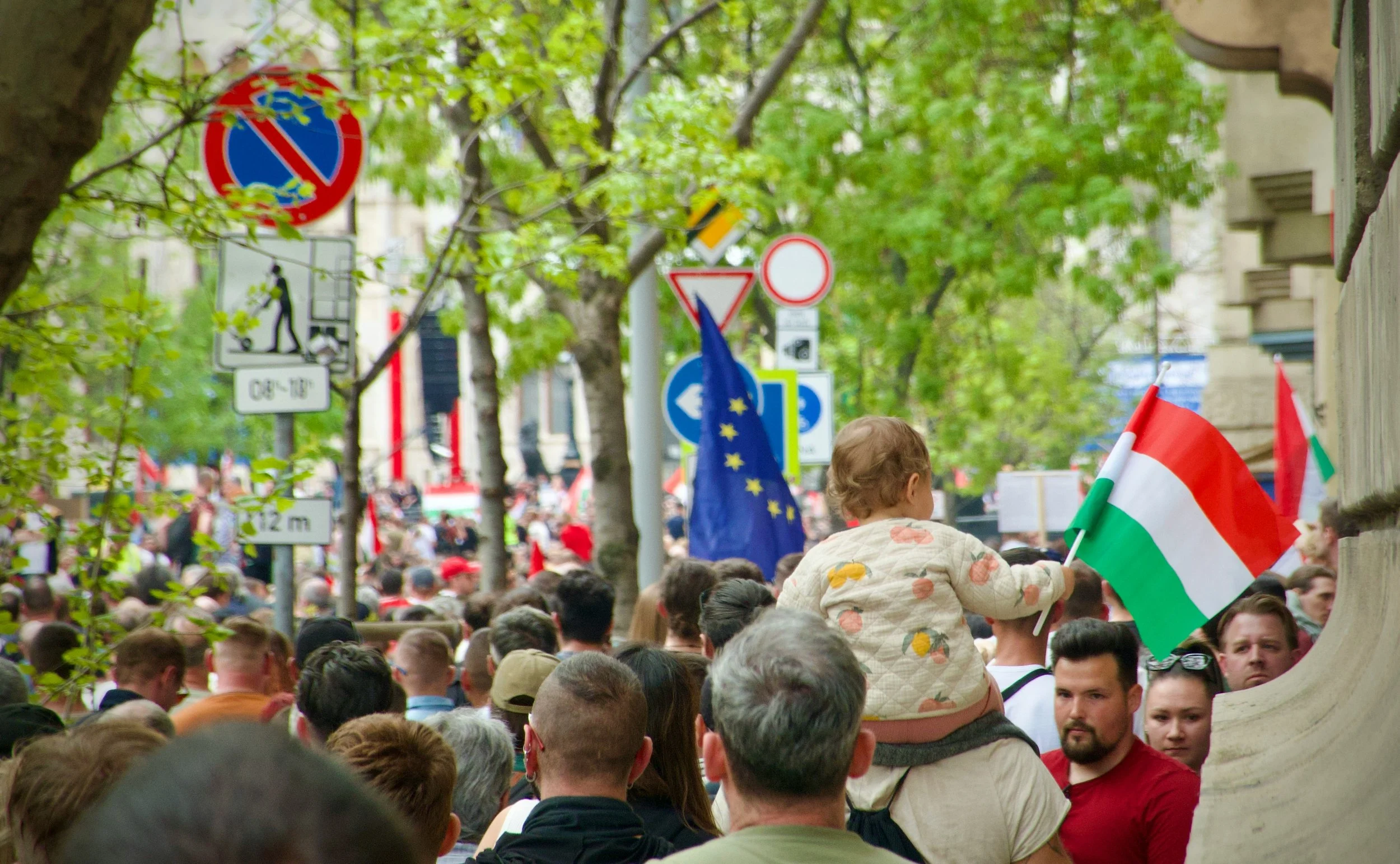
Photo by Mihály Köles on Unsplash
This essay builds on earlier reflections about Hungary's democratic opening by focusing on a different question: not why Orbán lost, but what forms of belonging and civic participation made democratic renewal possible in the first place and what they might mean for the future.
On the night of April 12, 2026, as the results of Hungary's parliamentary elections became clear, one chant rose repeatedly from the crowds gathered in Budapest:
"Europe! Europe! Europe!"
For outside observers, this may have sounded like a simple expression of relief after sixteen years of democratic backsliding under Viktor Orbán's government. But for many Hungarians, it carried a deeper meaning. It was a statement about belonging.
The significance of this moment cannot be understood solely through the lens of electoral politics. Hungary's democratic opening was certainly shaped by political leadership and electoral dynamics. But it was also the culmination of several slower and deeper transformations: the emergence of a generation shaped by European experiences, the rediscovery of civic agency through informal organizing, and the creation of new forms of belonging that transcend traditional political and institutional boundaries.
Belonging Beyond Borders
Since Hungary joined the European Union in 2004, an entire generation has grown up inside a European space of mobility and exchange. Hundreds of thousands of young Hungarians have studied abroad, volunteered internationally, worked across borders, built friendships and professional networks in other countries, and become accustomed to navigating multiple cultures and identities.
They did not experience democracy primarily as a constitutional arrangement or an abstract political ideal. They encountered it in everyday life: through freedom of movement, cooperation across differences, participation in shared projects, and the ordinary experience of living alongside people with different histories, languages, and perspectives.
Ironically, while Viktor Orbán's government spent years portraying Brussels as a threat to national sovereignty and presenting Europe as an external force imposing foreign values, an entire generation was quietly living Europe socially. Through friendships, studies, travel, work, and volunteer experiences, Europe became less an institution and more an everyday reality.
The chants of "Europe" on election night were therefore about more than foreign policy or institutional alignment. They expressed an understanding of belonging that does not replace national identity but places it within wider communities of cooperation and shared democratic values.
Rediscovering Agency
Yet what happened in Hungary was not simply a renewed sense of belonging, but its fuller expression in practice: the rediscovery of collective agency, the capacity not only to feel part of a shared “we,” but to act together in shaping its future.
When Péter Magyar emerged as a public political figure in 2024, following years in state-linked roles but largely outside the public eye, he invited supporters to join an online community called Talpra Magyar (“On Your Feet, Hungarians”). Over the following two years, he would develop from an unexpected critic of the governing establishment into a credible challenger to Viktor Orbán. Across the country, local groups quickly emerged. At first, there was no grand political project. There was simply a shared feeling that something no longer added up.
Official narratives described Hungary as strong, successful, and flourishing. Yet many people's everyday experiences suggested something different. Inflation had become increasingly difficult for households to absorb. Healthcare and education were visibly struggling. Independent journalists continued to report on corruption and extraordinary concentrations of wealth among political elites, despite the regime’s extensive efforts to control the media landscape.
People who had privately questioned official narratives suddenly found themselves sitting together in online and later physical spaces, discovering not necessarily that their doubts were new, but that they were widely shared. These spaces brought together people with different political backgrounds and motivations, including some who did not necessarily identify with Péter Magyar’s broader political project but shared a desire for change. For many, the obstacle had not simply been a lack of information, but a lack of trust, a sense of political isolation, or little reason to believe that a viable alternative was possible. What followed was therefore not simply a process of learning, but also one of building trust and a shared understanding of what could be changed.
These groups invited economists, teachers, doctors, historians, and public intellectuals to help them make sense of what was happening in their country. Why were hospitals struggling? Why had local governments become increasingly powerless? Why did public institutions seem unable to address obvious problems? Why did everyday experiences increasingly diverge from official narratives? These conversations did more than provide information. They helped turn individual experiences into a shared understanding, while building relationships and trust among people who had often felt politically isolated or powerless. Understanding became relationships, and relationships made action possible. Participants eventually reached a sobering conclusion.
National politics appeared inaccessible because of the overwhelming parliamentary dominance of the governing party. Municipal governments had been stripped of much of their authority and financial autonomy. Many formally independent institutions were widely perceived as politically captured.
The only remaining institution that people felt they could rely on was each other.
This realization became the foundation of an extraordinary process of civic self-organization. The local groups that eventually became known as "Tisza Islands" began undertaking remarkably simple activities. They organized discussions, invited speakers, helped vulnerable residents, visited neighboring communities, and talked to people.
Most importantly, they listened. Their activities required almost no money and no formal infrastructure. Yet they possessed something increasingly rare in contemporary politics: physical presence. Over time, an interesting contrast emerged. The presence of Viktor Orbán and his political system became increasingly virtual, experienced primarily through television, newspapers, social media, and billboards.
The Tisza Islands and Péter Magyar's movement became increasingly real. Over two years, Péter Magyar and local volunteers visited every settlement in Hungary multiple times. In villages and small towns where support for the governing party had been strongest, people encountered neighbors, teachers, entrepreneurs, retirees, and community leaders willing to engage in difficult conversations and discuss shared concerns face-to-face. In an era characterized by disinformation, polarization, and mediated politics, physical presence itself acquired political significance.
Equally important is what these groups were not. The Tisza Islands were not local branches of the Tisza Party. They were autonomous civic initiatives built by ordinary people seeking change. Their credibility derived precisely from their independence and from the trust already embedded in local relationships. The party itself eventually recognized the importance of these networks and invited local communities to nominate candidates from among their own members.
Whether this experiment can survive the transition from opposition to governing remains to be seen. But it represents something unusual in contemporary democracies: an attempt to translate local legitimacy and civic participation directly into political representation.
Perhaps the most important outcome was not electoral. For hundreds of thousands of people, this became the first direct experience in years that collective action is possible. That people can cooperate across differences, they can organize themselves and that they can shape outcomes.
Experiences of passivity gave way to experiences of agency. This may prove to be one of the most consequential transformations of this moment. What emerged in Hungary also reflects a broader phenomenon visible in many parts of the world.
The Return of Informal Civic Life
Over the past decade, attacks on democratic institutions and systems of checks and balances have increasingly been accompanied by a different promise: that strong leaders can protect vulnerable citizens more effectively than complex institutions can. Hungary followed this path for sixteen years. Yet many citizens gradually reached the opposite conclusion. Dismantling institutions does not eliminate complexity. It merely reduces society's capacity to manage it.
At the same time, people experienced something else. Informal civic action can often respond more quickly than institutions. Small groups can adapt, organize around relationships rather than procedures, and act locally without waiting for permission or resources.
The Tisza Islands belong to a much wider landscape of mutual aid networks, decentralized civic initiatives, and informal forms of participation that have appeared across many societies in recent years.
This creates an important democratic challenge. How can societies rebuild and reimagine institutions so that they become more responsive, participatory, and capable of earning citizens’ trust? And what might formal institutions learn from the relational and locally rooted forms of participation emerging outside them? How can governments, civil society organizations, and philanthropy engage with these informal civic initiatives without bureaucratizing them or undermining the very qualities that make them effective?
A New Democratic Generation
Perhaps this challenge is most visible among younger generations. The young people who came of age in Hungary over the past two decades learned democracy in ways that differ significantly from previous generations. They experienced Europe not primarily as an institution but as a lived reality. They became comfortable navigating difference and increasingly saw participation and cooperation as ordinary aspects of social life.
At the same time, they witnessed democratic backsliding, institutional decline, and growing political polarization in their own country. As a result, they developed a somewhat paradoxical relationship with democracy.
Many have grown up seeing pluralism, diversity, and democratic norms as a normal part of life, while experiences with volunteering, exchange programs, grassroots initiatives, and informal organizing have exposed them to forms of participation that take place outside formal political institutions and are rooted in relationships, communities, and collective action.
For many young people, participation did not begin with the 2026 election. They had already been practicing forms of democracy through volunteering, exchange programs, grassroots initiatives, local communities, and informal organizing. In this sense, they are not simply waiting to be invited into democracy. They have already been living it.
The experience of Hungary's democratic opening suggests that democratic renewal depends on more than electoral victories or institutional reforms. It also depends on whether people rediscover their capacity to understand reality together, build relationships across differences, and act collectively in pursuit of common goals.
These are also questions I am beginning to explore through the Common Ground LAB, a practice-based learning circle inspired by the Democracy & Belonging Forum at the Othering & Belonging Institute (OBI) and supported through its Network Catalyzers Program. Bringing together people working across civil society, education, culture, local government, and grassroots initiatives in Hungary and the wider region, the LAB creates a space to explore what capacities this new political period requires: how to move beyond modes of participation shaped primarily by political urgency, rebuild trust beyond familiar circles, cooperate across disagreement, and strengthen the relational foundations on which democratic life depends.
The opportunities for mobility, exchange, and cross-border connection created by Hungary’s integration into the European Union helped shape a generation increasingly comfortable with diversity and layered forms of belonging. Informal civic initiatives created new experiences of agency and participation. Citizens who had long experienced politics as something done to them began experiencing themselves as authors of public life.
Whether this energy can endure remains an open question. The habits of cooperation, trust, and participation that emerged during this period could gradually fade once the immediate political objective has been achieved. But they could also become the foundations of a different democratic culture or infrastructure.
Because democracy ultimately depends not only on institutions, elections, or constitutions. It depends on whether people believe they can shape their common future together.
This piece was written by György Hámori, who serves as a Network Catalyzer with the Forum, where he leads the Common Ground LAB.
The Common Ground LAB is one of several communities supported through the Forum's Network Catalyzers Program, a year-long initiative that supports members to launch their own communities around othering, belonging, bridging, and democracy. Catalyzers receive mentorship, peer support, and an honorarium to sustain their work. Explore the Network Catalyzers Program for more conversations and insights from community leaders supported by this initiative.
Editor's note: The ideas expressed in this blog are not necessarily those of the Othering & Belonging Institute or UC Berkeley, but belong to the authors.