
Regularización Ya!, a fearless migrant-led movement driving policy change in Spain

Mark Wang for Fine Acts x OBI
Update [April 2026]: Since this paper's publication, the Spanish Council of Ministers approved a law proposal for extraordinary regularization via Royal Decree on April 14, 2026—marking six years of collective migrant-led struggle. Following months of legislative deadlock, the governing coalition finally advanced the draft within the relevant ministries, resulting in a final text after prolonged negotiations that incorporated several of the movement's core demands.
Key protections were incorporated, including validation of expired passports, provisional work authorization upon admission, and coverage for people who entered Spain before 1 January 2026 with at least five months of demonstrated stay. But stateless applicants were not included, and an extension of the deadline through December 31, 2026, was rejected, partly due to the implementation of the EU Migration and Asylum Pact.
The Regularización Ya! movement celebrated this agreement, insisting it was made possible by years of political advocacy—from the signature campaign to the agreement between the governing coalition parties, PSOE and Sumar (including Podemos)—and by the sustained bridging work with institutions, businesses, the catholic church, and its faith-based organizations. All of this, despite continuous opposition from conservative and far-right actors, and disagreements with unions over administrative constraints and capacity gaps in foreign offices.
In 2020, amid the global pandemic, the antiracist, self-organized Regularización Ya! movement emerged across Spain. Embracing a participatory, assembly-based approach, and brought together through large online calls for action, the movement demanded that the Spanish government secure rights for over 500,000 migrants who continue to lack residency status. Without the security of residency, they face systemic inequality, discrimination, and violence—even public healthcare is inaccessible.
The movement has continued to build coalitions, incorporating diverse alliances—from anti-racist, antifascist, and feminist collectives to catholic faith-based organizations—engaging citizens and bridging political and social divides, while consistently advocating for a sense of belonging among migrants and within local collectives for social justice.
“The Regularización Ya! movement is a form of resistance amid a lack of political will. [....] There is fear, there is distrust about what policies will look like in a few years’ time, and about whether we will really be able to achieve this struggle that we believe is just, not an act of charity, it’s about granting rights to those who are sustaining the most precarious and essential jobs in Spain: care work, food harvesting, and hospitality—one of the main pillars of Spain’s economy—which are carried out by the bodies of migrant people” says Edith Espínola, a spokesperson for the movement who also represents the domestic and care workers’ association Servicio Doméstico Activo (SEDOAC), the sector with highest rate of informal employment in Spain, at 27 percent (1).
To achieve a policy of regularisation, the movement has chosen to advance the first-ever migrant-led Legislative Popular Initiative (ILP), a unique direct democracy mechanism in Spain that allows citizens to propose laws to the Congress (2). An ILP is centered on “issues that directly affect people’s everyday lives, but do not necessarily represent the interests or agenda of political parties with parliamentary representation,” as established by law (3). However, only recognized Spanish citizens are allowed to sign it. This means that, once again, migrants without Spanish nationality cannot participate in a political process that directly and dramatically impacts their lives—highlighting the extent of their exclusion from political and legal processes.
Aiming to overcome the usual power imbalances, Regularización Ya!’s collective resistance has been crucial in strengthening migrants’ agency and centering their voices in decision-making spaces. Choosing to stay independent from political agendas, the movement demonstrates key lessons and learnings in sharing purpose and building trustworthy alliances across divides. The movement influences various sectors, addressing their root interests, while aiming to unlock political consensus under migrant leadership.
“We deserve rights as people, as migrants who are not just passing through but are here to stay,” says Silvana Cabrera, another spokesperson for Regularización Ya! and a hospitality worker in the Valencian Community—the sector with the second-highest rate of work informality nationwide, at 24 percent (4).
“Every law on migration issues has been made without our migrant voices. We are here to change the rules of the game. It’s going to be us who shape the laws that cut through our realities. We want to build a paradigm shift in the imaginary around migration.” Doing so requires knowing and navigating a complex and changing public opinion landscape.
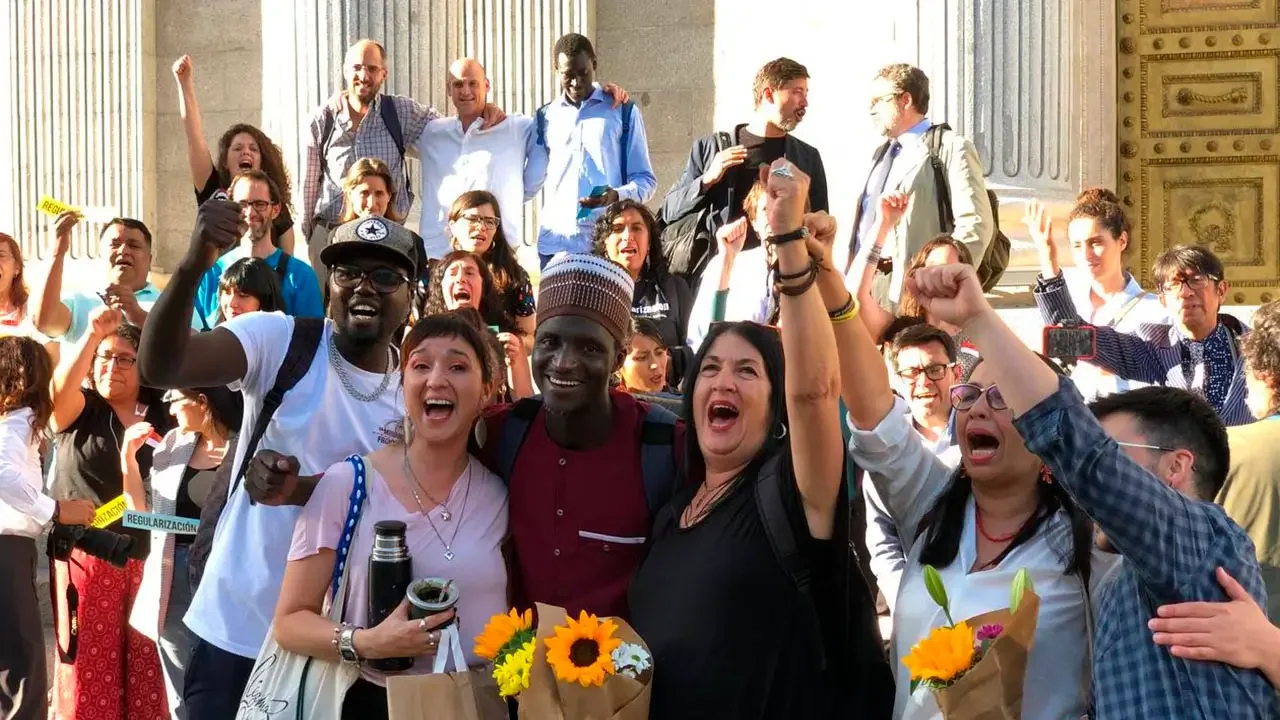
Movement members, including Silvana Cabrera (center-left), Victoria Columba (center-right) and Edith Espínola (second-right), celebrate the First Congress hearing by Regularización Ya! movement in May 2023 in Madrid.
Shifting perceptions of migration to confront a polarising, hostile context
Regularización Ya!’s efforts are taking place amid growing hostility towards migrants in Europe and a volatile landscape in Spain. While Italy, Greece, Portugal, France, and Germany have implemented harsher, polarizing policies—from expelling people in irregular situations and transferring them to third countries, to tightening border controls, integration rules, and asylum policies—the Spanish progressive governing coalition, led by Pedro Sánchez from the Socialist Party (PSOE), has prioritised a “pragmatic, yet deliberate approach” (5).
The Spanish government frames migration as an opportunity grounded in both economic and moral arguments. This approach presents paradoxes: it intends to make access to work and residency permits more flexible to solve labor shortages in key sectors, while enabling the economy to expand and tackling demographic decline. At the same time, it’s been accompanied by increases in securitization through the expansion of the migration control industry (6) and the promotion of “regular, orderly, and safe” circular migration programmes (7).
Spanish citizens in general tend to have a more favorable attitude towards migration than their peers in other countries. For instance, two years after the pandemic, 78 percent of Spanish people—across age and ideology—agreed on regularizing domestic and care workers, and 75 percent viewed immigration as an opportunity to address the challenges of depopulation and population aging. Even about 50 percent of far-right Vox party supporters agreed (8).
However, while Spanish public opinion on migration leans more positive, it is also susceptible to anti-migrant hate narratives (9), as research by different organizations and statistical agencies reveals. According to the barometer of the Center for Sociological Research (CIS), which tracks citizens’ priorities and concerns, migration became a top issue for the Spanish public in 2024 at levels not seen since 2006 and 2007, when nearly 32,000 people arrived in the Canary Islands (10). The salience of migration in the public’s imaginary was the result of increased arrivals—as over 6,000 people came to Spain via the same Atlantic deadly route during a two-month period in summer 2024—and constant efforts by far-right leaders to weaponize migration and promote hate speech, which other politicians from across the political spectrum have mimicked.
Spanish far-right parties have used migration to polarize public debate through disinformation and fear-based appeals to national identity and economic security (11)—claiming that the government grants nationality “cheaply” (12) or proposing “illegal deportations of around eight million migrants” (13). Vox, the only far-right party in Congress, fuels “us vs. them” narratives framing unaccompanied minors and people who arrive by sea as threats to public safety and falsely linking migration to crime, doing so both online and through unauthorized protests and intimidation at accommodation centers (14).
Tensions peaked in July 2025, as far-right rhetoric linking street attacks to migrants escalated within a week into violent riots targeting North African, migrant, and racialized communities in Torre Pacheco, Murcia (15). Earlier that year, a 2025 More in Common underscored how the frame of threat had taken root amongst Vox voters: about 61 percent of Vox supporters see migration as a threat—“more or less suggested by perceptions that immigrants receive preferential treatment” (16).
This political and social reality has not deterred activists; if anything, it has further encouraged migrants to advance an ILP for extraordinary regularization. The goal is to amplify a social justice perspective among citizens, a perspective that transcends the traditional business-driven and economic interest approach, by leveraging the public’s positive attitudes towards migration—which are still there. Shifting perceptions on migration do not displace the more immediate everyday challenges people face. In the last CIS survey from September 2025, people reported the economic crisis, access to housing, healthcare, and job quality as their most pressing and personal concerns ahead of migration (17).
The Regularización Ya! movement asserts that people’s rights—particularly those of migrants—cannot depend on the whims of changing public opinion, and focuses on the collective power of society and allied coalitions working together. “In the face of rising far-right forces, what better than ensuring everyone is protected with guaranteed rights? Instead of leaving them vulnerable to hate speech and injustice amid a dangerous world shaped by genocide, extractivism, and wars,” says spokesperson and networks and communications lead Victoria Columba.
“Regardless of far-right rhetoric and tough policies for outsourcing migration control, there is still an opportunity for progressive reforms in Spain with society’s support,” reflects Gonzalo Fanjul, Head of Research at porCausa Foundation, a Regularización Ya! ally. “The ILP has been both a symbolic and illustrative demonstration of that—the spectrum of organizations involved and its bridging value is truly powerful.”
Centering intersectionality in the struggle
In the fight for rights against the divisiveness of authoritarian populism, spokesperson Edith believes that political advocacy must be strategic, collective, and grounded in care. This struggle “should always be bigger than our individual struggles,” she says, to ensure that “everyone has the opportunity to work and contribute under fair, equal conditions.” That is why the Regularización Ya! movement is committed to closing the gap between legal eligibility and lived reality.
“While we started by talking about regularization, the word ‘legality’—and all it implies—was dropped from the vocabulary. No one is ‘illegal’!” Victoria explains. This shift in language reflects a broader strategy: to strengthen a migrant-led movement with intersectionality at the core—which means centering responsibilities, sharing privileges, and making solidarity essential across struggles.
“We see the State, not the people, as responsible for administrative irregularity, which is absolutely the absence of rights.” Victoria frames this irregularity as “a failure that can stop someone from reporting gender-based violence for fear of deportation, or leave migrants vulnerable to fines and arbitrary detentions—which can ultimately lead them to end up in a Foreigners’ Detention Centre (CIE” (18).
In Spain, the arraigo system allows people to regularize their status after demonstrating two years of residence, based on social or labor ties, education, family reasons, or as a second chance after a rejected residency renewal (19). However, migrants in irregular situations struggle to meet these requirements, leaving many trapped in a cycle of social exclusion. As spokesperson Silvana explains, “We know firsthand that not everyone has a valid passport or can obtain a criminal record certificate from their country of origin.”
Beyond these barriers, for many migrants, their demanding jobs make collective organizing difficult. Silvana’s experience illustrates these systemic challenges. She came to Spain in 2009 fleeing violence in her region of Bolivia, and looking for new economic opportunities. Nine years later, influenced by her family’s strong political and trade union background, she managed to join a migrant-led resistance collective in Valencia while still working tirelessly in hospitality. “Not everyone can get politically involved due to a lack of time,” Silvana reflects. “Many are surviving, trying to get out of extreme vulnerability situations. Some of us, who’ve gained certain privileges, can put our bodies at the forefront of the fight”.
Victoria shares this perspective and argues that, “Facing the growing far right, who openly seeks to expel us without legal consequences, we [as migrants] have the same right to speak out loud. When you have a privilege, you must share it and put it at the service of those left most vulnerable by public and migration policies.”

Members of Regularización Ya! joined feminists and anti-racists demonstrations in Valencia on 8 March 2024.
‘A common bold thread for migrant rights’: Refusing defeat and mapping the system in order to challenge it
The urgency for regularisation grew during COVID-19, as the health and socioeconomic consequences of the lockdown exposed the undeniable vulnerability of migrant people—especially those without residency papers, who kept working in harvesting, caregiving, and delivery (20). The risk of poverty for migrant families grew relentlessly, as they faced barriers to accessing the Ingreso Mínimo Vital—a social security benefit that guarantees a minimum income to those already in hardship (21). This reality also affected around 125,000 children and young people who inherited the irregular administrative status of their parents.
“That’s why we pushed for a regularization demand in 2020,” Victoria explains. “We clearly saw that migrant people would be hit hardest by public policies. Many people still had no access to any form of support. That’s when solidarity networks began to form, and the regularization movement spread nationwide.”
Edith, Silvana, and Victoria—together with Barcelona's Street Vendor Union (22), Huelva’s seasonal harvest workers’ associations (23), and nationwide representatives from the sex work industry, students, and allied NGOs—began organizing organically to demand solutions for all those left behind by social protection systems. “We started meeting in massive online calls with people from across Spain, something unimaginable before,” Silvana recalls. “How do we work together despite our differences? It became both a strategic attitude and a life commitment. A paradigm shift truly united us. We had a bold thread in common: defending migrants’ rights while agreeing on shared foundations to guide our work.”
In its early stages, the Regularización Ya! movement, working with diverse and inclusive allies, mapped the system; shared contacts, lessons, and know-how from members with historical advocacy experience; and expanded through digital organizing and adaptable mobilizations—creating an effective network across differences.
As Portugal and Italy passed partial regularizations during the pandemic, Regularización Ya! launched its first action in Spain. In April 2020, they sent an open letter—supported by over 1,200 antiracist, human rights, and migrant organizations—to the coalition government demanding “a broad, permanent, and unconditional regularization.”
However, this 2020 letter was met with silence, leading the movement to turn their demands into a proposición no de ley (PNL)—a non-binding resolution presented to Congress (24). In September of that year, the PNL was supported by eight political forces—from nationalist and independentist to progressive and left-wing parties—but it was rejected by the center-left incumbent PSOE Party (alongside the conservative Partido Popular (PP) and the far-right Vox party), who argued that a European mandate prevented member states from initiating a regularization process.
“We insisted relentlessly,” Silvana recalls. Having mapped allies, lawmakers, and legal frameworks, Regularización Ya! pushed back, reached out to EU representatives and obtained confirmation from the EU Commissioner for Home Affairs that: “The regularization of migrants in irregular situations is governed by national legislation.” With no EU policy limitations, a real opportunity emerged to rebuild social support and bring the regularization initiative back to Congress—this time backed by citizens—while migrants took to public spaces to demand their rights.
“When the lockdown ended, we gathered in front of the Congress building for a demonstration. After the PNL was rejected, we kept building political momentum through international organizations, reaching out to UN migrant rapporteurs and engaging with various political parties. That’s when we realized we could advance an ILP process,” Victoria recalls.
Migrant voices building belonging through the first-ever migrant-led ILP
“How can we collect at least 500,000 signatures from Spanish ID holders to support our regularization demand?” Silvana recalls asking. The ILP process requires not only gathering this level of support, but also doing so within a nine-month period.
“We started to get organized through territorial alliances and committees, but also to imagine all the ways on how to collect these signatures at festivals, concerts, schools, and universities—everywhere, all at once”, Silvana continues.
With the support of more than 900 organizations (25)—including anti-racist, antifascist, feminist collectives, NGOs, progressive and social-liberal parties, and faith-based groups—14,000 volunteers across 18 territorial committees gathered over 700,000 signatures, marking the first ever migrant-led movement to undertake an ILP initiative in Spanish democracy (26). This around-the-clock effort strengthened a sense of belonging among migrants and allies—especially those excluded from official social or legal protections.
“We were there on the streets asking for our rights through a democratic process, while the far right was amplifying their hate speech,” Silvana recalls. “But not a single left-wing party: just us [ILP promoters] and them [Vox party supporters],” Victoria continues. “We spent entire days through 2022 in the streets, and we’re still out here, demanding justice and fighting against racism. We continue witnessing firsthand what’s really happening.” All the while, the far-right was campaigning on the idea that migration is a problem, using othering narratives grounded in racism and criminalization.
Despite volunteers facing discrimination throughout the ILP campaign, they remain undeterred, driven by a deeper purpose. “It was such a symbolic, social consciousness process—where a migrant, often facing an irregular administrative situation or racialization, asks someone with an ID card to sign a regularization initiative,” Silvana explains.“Some people even said they weren’t aware that an ILP already exists in Spain.”
The ILP promoters explained to everyone not only how direct democratic mechanisms work, but also the social and legal vulnerability—and the invisibility—faced by those without residency documents. They also transformed the signature collection campaign into an inclusive tool for collaboration, connection, and persistence, while fostering understanding and challenging apathy and misinformation in public spaces.

Movement members, including Silvana Cabrera (second-left), Victoria Columba (center-right) and Edith Espínola (front-right), celebrate the Second Congress hearing by Regularización Ya! movement in March 2024 in Madrid.
Overcoming power imbalances within the ILP process
Regularización Ya! needed allies to stand behind one shared goal: the ILP had to be led by the migrant community itself—no one else. “Our strength lies not only in speaking about migration with our own voices, but in having migrant spokespersons who are street vendors, domestic and care workers, sex workers, harvesters, and hospitality workers,” Victoria celebrates.
To address power imbalances and advance strategies grounded in collective power, dignity, and mutual support, the Regularización Ya! movement held firm: migrant agency, voices, and lived expertise and experience should lead the ILP process, with allies supporting and creating space for migrant leadership.
One of Regularización Ya!’s biggest challenges has been tackling power imbalances within the ILP process—reflecting the broader underrepresentation and lack of recognition and diversity of migrant voices in Spanish public life.
“Our movement comes from an antiracist struggle, so we don’t want to give away our knowledge or allow any organization to extract from this fight,” Victoria continues. “Despite tough disagreements and doubts, our belief in the ILP kept us going. We couldn’t walk away from everything we had built.”
But how do their migrant-led demands help break those broader social dynamics while maintaining trust and cohesion? “Though Regularización Ya! movement was the smallest group building the ILP, we shaped the discourse—ensuring people understood why and from what position they supported us,” Silvana explains.
The ILP promoters brought together a grupo motor, specialists in sustainable ILP infrastructures, to support a signature campaign of this scale. At the onset, Regularización Ya! had to explain their demands to the group, “It was really exhausting at first because our reasoning was so different, but we always made sure the ILP stayed fully independent from any party or political agendas—and broke away from organizations that had taken over or even opposed our struggles as part of a broader rescue and war industry,” Victoria recalls.
That clear boundary strengthened community ties—and so did their relationships with allies, especially anti-racist feminist and human rights partners. “We made it clear to stay focused about what we want and how we want it,” Silvana adds. This is how they found profound solidarity with artists, producing a song through a collective creative process where signature promoters voice all their demands.
Even so, some political parties and NGOs disrupted dialogue by seeking visibility instead of supporting Regularización Ya!’s agency. Certain NGOs, used to acting as migration “guardians,” felt uneasy about not leading the signature campaign, at times sidelining migrant voices in some territorial committees.
“Left-wing parties also remain reactive to far-right migration discourses but lack a clear, rights-based migration perspective,” Victoria recalls. “We expected true commitment from allies, who should have opened their spaces for signatures without prioritizing their own agendas.”
The movement also rejected meritocratic arguments that regularization should be conditional, like “if these people do things our way, that’s better!” Victoria argues, “Integration is a supremacist term for us, implying fitting into a system that rejects people because of status, language, religion, or skin color. We insisted on inclusion in public policies instead.” This marks another important shift: inclusion recognizes migrants—and also opens the door to co-creating belonging—ensuring migrants have opportunities to participate in shaping the political, social, and cultural structures that govern their lives (27).
Another key strength of the movement comes from members’ legacy of solid, assertive advocacy. “From the domestic and care work movement, we’ve learned that our voice as migrants, especially as migrant women, is incredibly powerful. Everyone of us says: ‘I’ve come this far, and you need to walk with me—either beside me or behind me, but never ahead of me,'” Edith says.
Gonzalo from porCausa believes that this is one of the biggest challenges for social movements in Spain, “that people like me step back and speak less so migrant-led movements can truly be heard, even if not everyone agrees with them.” He adds, “This means consciously letting go of privileges we’ve had over the years, allowing migrant voices to grow stronger and push institutions to engage.”
Now, Regularización Ya! stands as a recognized voice on migration issues, despite years of advocacy fatigue and limited resources. “We’ve been here from the start, a team that’s come this far thanks to a strong network of bonds and mutual care,” Silvana says.
Victoria also sees the movement's commitment and resilience “as a responsibility to those living in social exclusion and to future generations who will see that it’s possible to organize, nurture a community, and build spaces where migrant rage, struggle, and dignity can grow.”
Bridging and belonging through a migrant-led initiative: the role of business and faith-based organizations
This collective commitment to build a migrant-led movement has been supported by a diverse range of allies, each bringing different beliefs and forms of influence to a common cause. Employers and companies associated with the Confederación Española de Organizaciones Empresariales (CEOE), along with catholic bishops, their pastoral workers via the Conferencia Episcopal Española (CEE), and religious charity groups such as Cáritas, are pressuring lawmakers, especially the conservative PP party, to approve regularization using both economic and compassion-based arguments (28). They highlight the urgent need for workers, as well as the positive impact regularization would have on people’s lives.
In summer 2025, Cáritas attended a parliamentary commission session to advocate for regularization from the church’s position. “They supported our discourse, embracing social justice as their biggest step forward. We are definitely shaping language through our alliance work,” Victoria celebrates on behalf of the Regularización Ya! movement.
Business employers have also played an increasingly influential role. “If they talk about the need to regularize migrants’ administrative status to meet labor demands, they’re coming from an economic perspective. Meanwhile, from the regularization movement, we’re pushing forward with a human rights perspective. Well, we’ll push through from our different perspectives, won’t we?” Victoria reflects. While the Regularización Ya! movement continues to advance its core commitment to social justice while pursuing regularization, it continually reflects on how these different perspectives and motivations can intersect and be used strategically, even when they differ—building across divides is part of that strategy.
Together, these allied efforts increase pressure on opposing parties, pushing for progress despite political agendas. Parliamentary groups—including the government’s partner Sumar and other parties—have focused part of their work on advancing the regularization law in Congress, aiming to secure migrant rights ahead of upcoming political challenges.
One of these political challenges is the recent Pact on Migration and Asylum, a new EU legal act designed to establish a unified approach for managing migration and asylum across the EU (29). “There’s some fear around the European Commission’s role in overseeing national regulations,” reflects Spanish Deputy Aina Vidal Sáez, spokesperson for En Comú Podem and the Sumar parliamentary group. “It’s an authentic disaster approved at the heart of Europe. This pact will inevitably create conflict and force Spain to politically transition its current legislation, as it clearly infringes on rights and contradicts domestic laws that guarantee protections, such as asylum.”
Victoria offers a pragmatic take on why the movement found it crucial to speak out against this pact: “This pact was not only ratified but also shaped by a coalition of both progressive and conservative parties.” She emphasizes that the Regularización Ya! movement’s approach—engaging strategically with allies and bridging divides constructively, while “remaining unapologetically radical in their demands and vision for change”—can directly challenge these kinds of political agreements rooted in fear and division, even though, as she notes, the policymakers who signed this pact “none of which belong to the far-right.”
In response to these challenges, the movement focuses on building a migrant-led lawmaking capacity to face resistance and drive political shifts through administrative decisions—meaning closing the gap between collective power and institutional responsiveness to ensure that people in irregular situations are not left behind.
Reaching political consensus within parliamentary groups is key to unlocking approval for the regularization, but securing it through a unified text is particularly important for Regularización Ya! “We’re fighting tirelessly to be part of the law’s drafting process and to close any ‘fine print’ that could lead to misinterpretation,” Victoria explains. “We want it crystal clear who will have their administrative status regularized. It must include everyone already on Spanish territory before the ILP’s approval and remove the work contract as a requirement.”
Across partisan divides, pushing for political will
Regularizations are not new in Spanish politics: since 1991, both conservative and progressive governments have approved at least six major extraordinary regularization processes, mostly focused on granting work and residency authorizations to meet workforce demands, with the largest being in 2005.
Recently, these measures have been adopted differently, for example, in cases of natural disasters (30). In October 2024, a heavy weather phenomenon called DANA—a Spanish acronym for Depresión Aislada en Niveles Altos, or ‘cold drop,’ causing intense storms and severe flooding—hit the Valencian Community. DANA caused human loss and destruction in 70 municipalities (31), particularly affecting migrant communities already excluded from economic support and vulnerable to hate speech, disinformation, criminalization, and barriers to subsidies (32). To help face the socio-economic crisis, the Spanish Council of Ministers approved an extraordinary regularization for around 25,000 migrant people, granting a one-year residence and work permit. “It shows that pushing for extraordinary regularizations in Spain is possible,” Silvana insists.
However, these applications still require some of the same conditions as the arraigo process, such as the certificado de empadronamiento—a municipal registration certificate that people in irregular administrative situations often struggle to obtain. Beyond political will, administrative capacity is also crucial. Silvana reflects on what the process in Valencia revealed: “Immigration offices need more human and economic resources to manage these requests without delays”.
Since Congress considered the ILP as a formal law proposal on 9 April 2024—with support from all groups except Vox and an abstention from the PP—the Regularización Ya! movement has been pushing for political will across divides. Their purpose: advance lasting reform for unconditional migrant rights despite partisan calculations and fears of backlash.
Deputy Aina called the 2024 vote “a real success, the fruit of pressure from many groups—from religious entities, including the church and charities, to business employers—but above all, Regularización Ya!’s political advocacy.” Still, she adds, “some parties didn’t want to approve the ILP, but they couldn’t ignore the need to debate it in Congress.”
Silvana insists that regularization demands are “still not a political priority.” Efforts through communications, social media campaigns, and fact-checking news and publications have remained relentless in pushing for its final approval. “It’s been madness,” she recalls. “We are few people who are also engaging with political parties, ministries, Members of the European Parliament, NGOs… with everyone!”
“Thanks to the pressure that Regularización Ya! has been exerting, the government adjusted its strategy a bit,” Aina recalls. This shift was driven partly by that pressure, but also by a legal error introduced in the latest immigration reforms, which left more than 270,000 asylum seekers without administrative support. As a result, after five years of opposition, the coalition government changed its stance on the ILP: moving from arguing that arraigo pathways were sufficient to address administrative irregularity to recognizing a regularization measure might be part of the solution (33).
Between May and July 2025, the coalition government renewed contacts with several parliamentary groups to gather support for the regularization bill in Congress. As of today, the ILP remains stalled (34). Victoria identifies this ILP as the first to overcome major political and institutional obstacles—it also offers a valuable learning opportunity. “It’s an embarrassment that the only tool we have in direct democracy to change laws can’t move forward.” Aina agrees: “If citizens can organize an ILP and exercise this power, reaching institutions shouldn’t be this difficult.”

Spanish citizens gathered in Algeciras to support the ILP initiative during its signature campaign in 2022.
From struggle to belonging: Lessons in bridging divides from a migrant-led initiative
Despite the challenges, Silvana celebrates one of Regularización Ya!’s greatest achievements: “We’re not just a movement demanding social justice—we’ve shaped a school of politics to build representation and speak to the issues that affect us deeply.”
Silvana realized that political advocacy gave her and fellow members not just a sense of belonging to a caring community, but also a way to embody both the claim to rights and the right to belong: “Feeling that security in learning more about our rights and, most importantly, understanding the deepest desires of our community.” Regularización Ya! has shown what is possible when migrants lead the fight for their rights, offering important lessons in bridging and belonging.
It has shown that a direct democratic process is possible by amplifying the real, positive attitudes of Spanish society towards migration—moving beyond public perceptions shaped by noise, hate speech, and far-right rhetoric. Regularización Ya! fiercely demands that migrants’ voices be centered, bringing their expertise and experiences across sectors to overcome internal and broader social power imbalances. Staying migrant-led and politically independent has been crucial, while encouraging allies to step back and reflect on how and from where they can best support.
Intersectionality has also been key. Building alliances across divides requires care, dignity, and persistence to sustain momentum despite pushbacks, while sharing privileges, centering responsibilities, and fostering solidarity across migrant and social struggles. By adopting a strategic attitude of working together despite differences and setting clear positional boundaries, Regularización Ya! was able to map allies, legal frameworks, and lawmakers to know exactly which path to take. Movement members and allies shared contacts and advocacy know-how through territorial committees, digital organizing, and mobilizations that kept migrants’ rights visible and maintained pressure on institutions and public spaces.
The movement has shown that strategic pluralism is essential for navigating complex political landscapes, with diverse actors using their capacity to have influence in different spaces. Gonzalo from porCausa calls these “unlikely coalitions—people who wouldn’t otherwise come together, [and] yet in this regularization movement, they remain committed."
From adapting tactics to build broad public support, to shaping language across sectors under migrant leadership, Regularización Ya! has advanced an ILP to demand inclusion over integration, to challenge apathy and disinformation, and to counter narratives of otherness—all while bridging divides and fostering a sense of belonging.
“Regularización Ya! is a great example of how to organize ourselves with hope, centering those for and with whom we fight for human rights and territory,” Silvana celebrates, especially at a time when authoritarian populism is on the rise. “At both the European and global levels, if the Spanish government approves a law proposal driven by migrants to guarantee our access to rights, it would definitely mark a historic shift”.
Endnotes
1. Fanjul, Gonzalo, and Gálvez-Iniesta, Ismael. 2022. “Cinco Buenas Razones Para Aprobar Una Regularización Extraordinaria de Migrantes Sin Papeles.” Informe Esenciales [“Five Good Reasons to Approve an Extraordinary Regularization of Undocumented Migrants”. Esenciales Report], March, 7. https://porcausa.org/wp-content/uploads/2022/03/Informe_Esenciales_2022.pdf.
2. Constitución española de 1978. 2023. “Título III. De Las Cortes Generales - Constitución Española.” ["Title III. On the Spanish Parliament (Cortes Generales) – Spanish Constitution."]
3. Boletín Oficial del Estado. 2006. “BOE-A-1984-7249 Ley Orgánica 3/1984, de 26 de marzo, reguladora de la iniciativa legislativa popular.” Prefacio. ["BOE-A-1984-7249 Organic Law 3/1984, of March 26, regulating the popular legislative initiative." Preface.] May 27, 2006. https://www.boe.es/buscar/act.php?id=BOE-A-1984-7249.
4. Fanjul, Gonzalo, and Gálvez-Iniesta, Ismael. 2022. “Cinco Buenas Razones Para Aprobar Una Regularización Extraordinaria de Migrantes Sin Papeles.” Informe Esenciales [“Five Good Reasons to Approve an Extraordinary Regularization of Undocumented Migrants”. Esenciales Report], March, 7. https://porcausa.org/wp-content/uploads/2022/03/Informe_Esenciales_2022.pdf.
5. Encarnación, Omar G. 2025. “Spain Is Going Its Own Way”. The New York Times. August 11, 2025. https://www.nytimes.com/2025/08/11/opinion/spain-immigration-sanchez-amnesty.html.
6. Fundación porCausa. n.d. “Industria del control migratorio” [“Migration control industry”] Accessed July 29, 2025. https://porcausa.org/somos-lo-que-hacemos/industria-del-control-migratorio/.
7. Directorate-General for Migration and Home Affairs. 2025. “Spain: New Order for Migrant Employment and Circular Migration - European Commission.” January 13, 2025. https://home-affairs.ec.europa.eu/news/spain-new-order-migrant-employment-and-circular-migration-2025-01-13_en.
8. Juan-Torres González, Míriam. 2022. “Navegando La Incertidumbre - España.” [“Navigating Uncertainty – Spain.”] https://www.moreincommon.com/media/vkwb24py/2022-navegando-la-incertidumbre.pdf.
9. González Enríquez, Carmen, and Rinken, Sebastian. 2021. “La opinión pública ante la inmigración y el efecto de VOX.” [“Public opinion on immigration and the VOX effect”] March 2021.https://www.realinstitutoelcano.org/analisis/la-opinion-publica-ante-la-inmigracion-y-el-efecto-de-vox/
10. Bermejo Casado, Rut, and González Enríquez, Carmen. 2024. “La opinión pública española sobre la inmigración en contexto.” [“Spanish Public Opinion on Immigration in Context”] October 3, 2024. https://www.realinstitutoelcano.org/comentarios/la-opinion-publica-espanyola-sobre-la-inmigracion-en-contexto/.
11. Sánchez, Gabriela. 2025. “El PP vota con Vox a favor de acabar con la única vía para regularizar a migrantes que llevan años en España.” [“The PP votes with Vox in favor of ending the only pathway to regularize migrants who have been in Spain for years”] September 16, 2025. https://www.eldiario.es/desalambre/congreso-rechazara-bloque-vox-elimiar-unica-via-regularizar-migrantes-han-vivido-anos-espana_1_12608187.html.
12. Maldito Bulo. 2025. “La ‘regularización de 900.000 inmigrantes’ en España no les concede la nacionalidad pero sí posibilita comenzar a cumplir los requisitos”. ["The regularization of 900,000 immigrants in Spain doesn't grant them citizenship, but does allow them to begin meeting the requirements."] Maldita.es. May 28, 2025. https://maldita.es/malditobulo/20250528/gobierno-regularizacion-900000-nacionalidad-inmigrantes/.
13. Castellano, Nicolás. 2025. “Desmontamos los bulos de Vox sobre su plan de expulsar a ocho millones de migrantes en España” [“We debunk Vox’s hoaxes about their plan to expel eight million migrants in Spain.”]. Cadena SER. July 8, 2025. https://cadenaser.com/nacional/2025/07/08/desmontando-los-bulos-de-vox-sobre-su-plan-de-expulsar-a-ocho-millones-de-migrantes-cadena-ser/.
14. Carmona, Jose. 2025. “Vox difunde su odio frente a un centro de menores migrantes bajo un fuerte despliegue policial” [“Vox spreads its hate in front of a migrant youth center under a heavy police presence”] Público. September 2, 2025. https://www.publico.es/politica/vox-difunde-odio-frente-centro-menores-migrantes-bajo-fuerte-despliegue-policial.html.
15. There in Torre Pacheco—a place where labor precarity is widespread and institutional protection remains largely absent—white supremacist terrorism and xenophobic rhetoric circulating online collided with deep-rooted structural racism, stigmatization, and hate speech. See Gwyn Jones, Mared. 2025. “How Disinformation Fuelled Spain’s Anti-Migrant Riots after Attack on Pensioner | Euronews.” July 18, 2025. https://www.euronews.com/my-europe/2025/07/18/how-disinformation-fuelled-spains-anti-migrant-riots-after-attack-on-pensioner; Cáceres, Paula. 2025. “Lo de Torre Pacheco tiene un nombre: terrorismo supremacista blanco.” [“What happened in Torre Pacheco has a name: white supremacist terrorism.”] July 15, 2025. https://osalto.gal/opinion/lo-torre-pacheco-tiene-un-nombre-terrorismo-supremacista-blanco; Guzmán, Javier. 2025. “Torre Pacheco: el síntoma de un sistema agroexportador podrido.” [“Torre Pacheco: the symptom of a rotten agro-export system.”] July 14, 2025. https://www.elsaltodiario.com/opinion/torre-pacheco-sintoma-una-sistema-agroexportador-podrido.
16. More in Common en España. 2025. “Europe Talks Migration España, 2025.” https://www.moreincommon.com/media/2l4j04mq/_informe-europe-talks-migration-espan-a-2025.pdf.
17. Centro de Investigaciones Sociológicas (CIS). 2025. “Barómetro de Septiembre 2025 Estudio No 3524.” [“September 2025 Barometer Study No. 3524.”] https://www.cis.es/catalogo-estudios/resultados-definidos/barometros
18. “Immigration detention centers were first established in Spanish law through Article 26 of Organic Law 7/1985, passed on July 1st. This law allows a judge to order that a foreign national be held—not in a prison, but in a designated facility—while their deportation process is underway. This is a precautionary measure ordered and supervised by a judge". See BOE-A-2014-2749. 2014. Real Decreto 162/2014, de 14 de Marzo, Por El Que Se Aprueba El Reglamento de Funcionamiento y Régimen Interior de Los Centros de Internamiento de Extranjeros. ["BOE-A-2014-2749. 2014. Royal Decree 162/2014, of March 14, Approving the Operating Regulations and Internal Rules of Foreigners' Detention Centers."] https://www.boe.es/buscar/doc.php?id=BOE-A-2014-2749; “Country Report: Conditions in Detention Facilities - Spain.” 2025. https://asylumineurope.org/reports/country/spain/detention-asylum-seekers/detention-conditions/conditions-detention-facilities/.
19. The arraigo system was introduced in 2000 through reforms to the 1985 immigration law. See BOE-A-2000-544. 2000. Ley Orgánica 4/2000, de 11 de enero, sobre derechos y libertades de los extranjeros en España y su integración social. ["Organic Law 4/2000, of January 11, on the rights and freedoms of foreigners in Spain and their social integration."] https://www.boe.es/buscar/act.php?id=BOE-A-2000-544.
20. Cortes Generales XIV legislatura. 2023. “Diario de sesiones del Congreso de los Diputados - Comisiones Trabajo, Inclusión, Seguridad Social y Migraciones. Núm. 899, Sesión Núm. 30.” ["Record of Proceedings of the Congress of Deputies – Committee on Labor, Inclusion, Social Security, and Migration. No. 899, Session No. 30."] May 10. https://www.congreso.es/public_oficiales/L14/CONG/DS/CO/DSCD-14-CO-899.PDF.
21. Fanjul, Gonzalo, and Gálvez-Iniesta, Ismael. 2022. “Cinco Buenas Razones Para Aprobar Una Regularización Extraordinaria de Migrantes Sin Papeles.” Informe Esenciales [“Five Good Reasons to Approve an Extraordinary Regularization of Undocumented Migrants”. Esenciales Report], March, 26. https://porcausa.org/wp-content/uploads/2022/03/Informe_Esenciales_2022.pdf.
22. Molina, Susana F. n.d. “A Rebellious Brand Born in Barcelona Sways the Weight of Language — Democracy & Belonging Forum.” Accessed July 29, 2025. https://www.democracyandbelongingfo rum.org/paper-series/cz26kk5cxdfwdrbtnzv3f50dkeigbr.
23. Diop, Seydou. 2020. “¿Saben todos en qué condiciones las personas migrantes recogemos la comida que los alimenta?” [“Does everyone know under what conditions migrant people harvest the food that feeds them?”] Migrados, Planeta Futuro, EL PAÍS. July 22, 2020. https://elpais.com/elpais/2020/07/20/migrados/1595256198_059485.html.
24. “TÍTULO X. De las proposiciones no de ley (Arts. 193-195) - Congreso de los Diputados.” [“TITLE X. On Non-Legislative Proposals (Articles 193-195) – Congress of Deputies.”] n.d. Accessed July 29, 2025. https://www.congreso.es/es/cem/t10
25. ESencialES. n.d. “Iniciativa Legislativa Popular Regularización extraordinaria de personas migrantes” [“Popular Legislative Initiative for the Extraordinary Regularization of Migrants”] Wikizens. Accessed July 29, 2025. https://www.wikizens.com/index.asp?id=1000XVP.
26. The signature campaign began in December 2021, and a year later, they delivered the signatures to the Electoral Census for certification. Out of more than 700,000 signatures collected, 612,275 were officially validated. Once approved, Regularización Ya! defended the initiative during two opening statements before the parliamentary commission on migrations, in May 2023 and March 2024. See Cortes Generales XIV legislatura. 2023. “Diario de sesiones del Congreso de los Diputados - Comisiones Trabajo, Inclusión, Seguridad Social y Migraciones. Núm. 899, Sesión Núm. 30.” ["Record of Proceedings of the Congress of Deputies – Committee on Labor, Inclusion, Social Security, and Migration. No. 899, Session No. 30."] May 10. https://www.congreso.es/public_oficiales/L14/CONG/DS/CO/DSCD-14-CO-899.PDF;
27. “What Is Belonging?” n.d. Othering & Belonging Institute. Accessed September 23, 2025. https://belonging.berkeley.edu/what-belonging.
28. Cortes Generales XV legislatura. 2025. “Diario de sesiones del Congreso de los Diputados - Comisiones Trabajo, Inclusión, Seguridad Social y Migraciones. Núm. 368, Sesión Núm. 18.” [“Record of Proceedings of the Congress of Deputies – Committee on Labor, Inclusion, Social Security, and Migration. No. 368, Session No. 18.”] June 18. https://www.congreso.es/public_oficiales/L15/CONG/DS/CO/DSCD-15-CO-368.PDF.
29. European Commission. 2024. Pact on Migration and Asylum. Brussels: Migration and Home Affairs. https://home-affairs.ec.europa.eu/policies/migration-and-asylum/pact-migration-and-asylum_en.
30. Villaverde, Javier. 2024. “Las regularizaciones extraordinarias de inmigrantes en España - Newtral.” [“The Extraordinary Regularizations of Immigrants in Spain”] April 12, 2024. https://www.newtral.es/las-regularizaciones-extraordinarias-de-inmigrantes-que-ha-habido-en-espana/20240412/.
31. “DANA in Valencia: Heartbreaking figures that tell a sad story | Ivie.” 2024. The Valencian Institute of Economic Research (Ivie). November 15, 2024. https://www.ivie.es/en_US/la-dana-deja-en-valencia-cifras-que-duelen-sobre-las-que-reflexionar/.
32. “DANA: El 30% de Los Discursos de Odio Dirigidos a La Población Migrante.” [“DANA: 30% of Hate Speech Targeted at the Migrant Population”] 2024. RTVE.Es. December 17, 2024. https://www.rtve.es/noticias/20241217/discursos-odio-noviembre-poblacion-migrante-dana/16376038.shtml.
33. “El Gobierno se vuelca con la regularización de inmigrantes para enmendar los errores del reglamento de extranjería.” [“The government prioritizes migrant regularization to address flaws in the immigration regulations”] n.d. El PAÍS Exprés | EL PAÍS. Accessed September 23, 2025. https://elpais.com/expres/2025-05-19/el-gobierno-se-vuelca-con-la-regularizacion-de-inmigrantes-para-enmendar-los-errores-del-reglamento-de-extranjeria.html.
34. Fanjul, Gonzalo. 2025. “Aún estamos a tiempo para la regularización de inmigrantes. [“We still have time for the regularization of immigrants”]. Opinión | EL PAÍS.” El País. September 30, 2025. https://elpais.com/opinion/2025-09-30/aun-estamos-a-tiempo-para-la-regularizacion-de-migrantes.html.
Author bio:
Mayra Alejandra Margffoy Tuay is an interdisciplinary migrant journalist and strategic, creative consultant committed to social and environmental justice and equity. She partners with purpose-driven, independent media outlets, social justice nonprofits, and community-led organizations to design and implement strategies that meet audience needs, co-create with communities, build meaningful participatory products and experiences, and amplify impact to drive change at multiple levels. Originally from Colombia, she calls Spain home.
Photo credit: Regularización Ya! movement
Editor's note: The ideas expressed in this blog are not necessarily those of the Othering & Belonging Institute or UC Berkeley, but belong to the authors.