Overview

The Lines that Whisper Us: Rethinking Agency and Accountability in the Middle East through the More-than-Human
“The world is at war. In the grip of lines and stencilled territories, we enact logics that exceed us, that transgress the categoricity of morally independent actors, and that might offer us a strange bewildering other thing, a line of flight away from this toxic convergence of lines. In such a world, no move is too small: every gesture ripples out into a vast tumble and tangle of things, potentizing this forest with new intelligences, with the soft response that might invite us to consider that solutions may get in the way of transformation, and that the thing to do is dance with the trouble.”

Othering & Belonging 2023 - Berlin
Join us on October 26-27, 2023 in Berlin for a dynamic gathering of changemakers, scholars, and artists committed to building inclusive and democratic futures in Europe, the US, and around the world. Share and learn new ideas and practices to strengthen democracy and belonging —with the urgency this moment requires, and the joy and hope our movements need.

Slow and Mainstream Wins the (Far Right) Race: the mainstreaming of authoritarian populist ideas on migration and climate
If migration is the key topic of modern authoritarian populists, the Spanish far right party has not been an exception in promoting anti-immigrant sentiment. Rhetorically, they have unrelentingly framed unaccompanied minor migrants as criminals in insistent and odious campaigns. Now, for many not on the far right, including some young progressives, this acronym immediately brings up fears rather than compassion or solidarity. This is the frame that dominates, whether the far right is in the room or not. Far-right ideas have become detached from far-right actors.”

On Europeans (not) Talking About Race
“Europe doesn’t talk much about race. Although some have a lot to say about racism in Europe and there are well-established anti-racist organizations across the continent, others easily conclude the conversation with something along the lines of “this is not an issue in this continent,” “it’s not about race, it’s about modern migration,” or, often, “but we are not the US.”

Forum Facilitator Vanessa Faloye on holding spaces of conflict to build radical belonging
“We are committed to unlocking the possibilities that exist beyond the story that difficult conversations of conflict, difference, or injustice must be avoided out of fear, won out of righteousness, or bulldozed with aggression. We want to co-create a countercultural movement of people relating to difference, reframing conflict, and practicing bridging and belonging in ways that both ground in and build toward our vision of justice and liberation.”
Unpacking the Far Right’s Gender Politics
“… in matters of gender there are actually many differences within and between far right parties and movements in different parts of the world. The far right often adopts liberal frames when convenient, but across the board we observe a more mixed bag of narratives and policy proposals. “

Enough is Enough: The Psychology Behind Authoritarian Populist Discourse
In recent years, political scientists, psychologists, and commentators have grown increasingly interested in the psychological theories that explain political and social attitudes. Threat perception, the Authoritarian Dynamic, Moral Foundations Theory, and Social Dominance Theory are models that are likely to evolve and improve, but they serve as useful frameworks to understand the current moment and build empathy for those who have a different worldview - wherever you stand.

OBI in Nonprofit Quarterly: Forging a Progressive Response to Fragmentation
How can social justice movements address the threats posed by democratic degradation and populist authoritarianism while advancing their longer-term goals? How can they reorient their work towards an ethos of defragmentation, bridging, and democratic renewal? It is to these questions that we turn.

Anna Szilágyi on how words can counter othering and promote belonging
“Words can lure groups and communities into dangerous and destructive ideologies, turning them into ardent supporters of disastrous deeds and policies. However, language can also serve as a bridge that unites people and fosters healing on a collective level.”
Diving into Migration's 'Narrative Ocean'
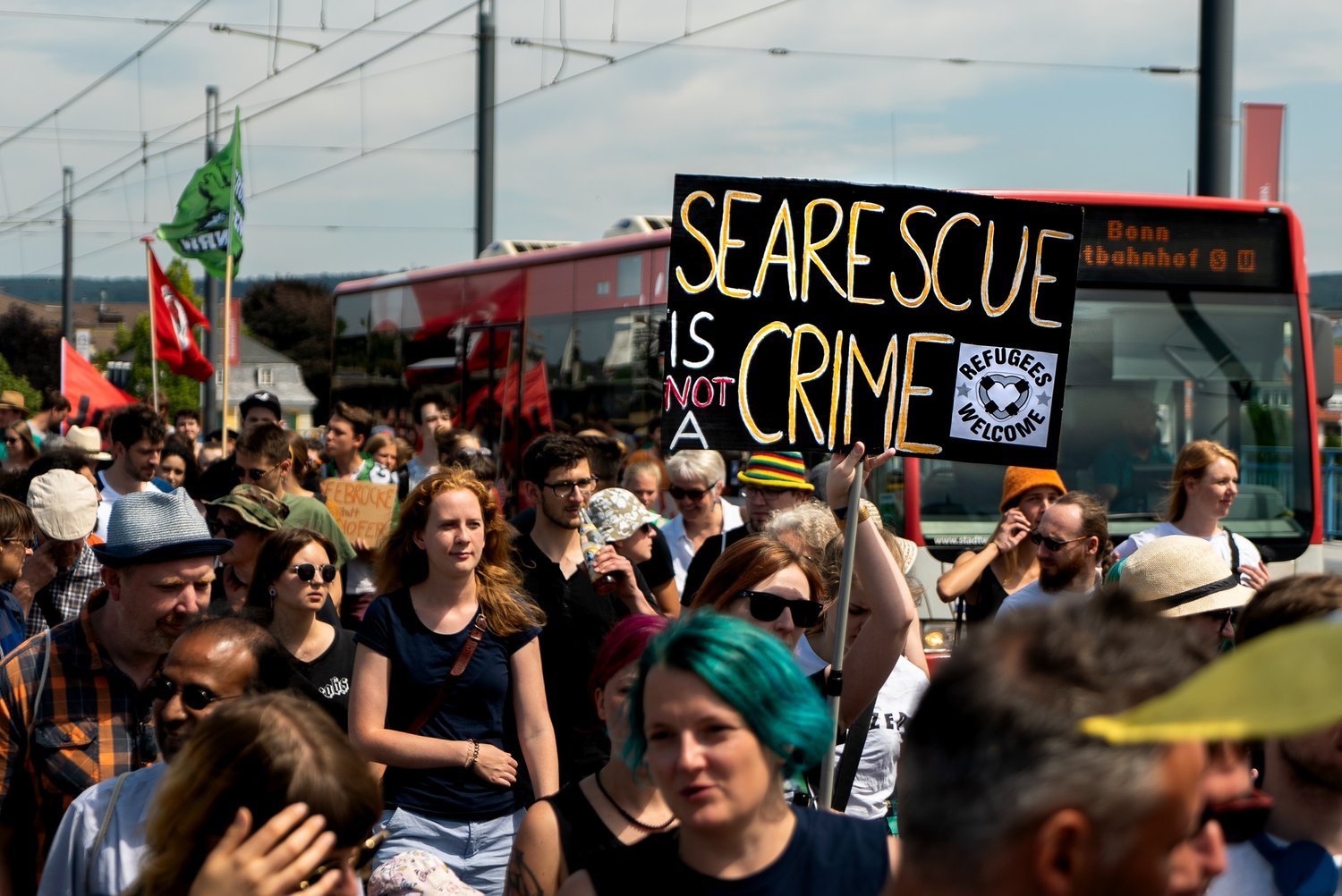
It is my belief that in no other domain – and I will admit that having worked in this space I may be slightly biased – do we see the power of narrative oceans more strongly than in migration. Unfortunately, the loudest stories that dominate the migration narrative ocean share a thread of othering and dehumanization.

In Conversation: Bayo Akomolafe on “Black Lives Matter: But to whom?”
“‘I’ wrote this essay with an eye of Black geographies, haunted outdoors, the hidden public that subsidizes the obvious. From within that space, there is - in my opinion - a groundswell of impulses and movements gesturing towards the more-than-just. Gesturing towards 'breaks' of some kind. This essay is an attempt to trace those wandering yearnings for another sun.”

NEW ESSAY: Black Lives Matter: But to Whom?
We're thrilled to share an extraordinary new work from our Global Senior Fellow Bayo Akomolafe. In many ways, Bayo's piece defies any simple description or summary, but at its most basic, this two-part essay seeks to explore the limits of the Black Lives Matter frame in advancing justice and the possibility for reimagining identities altogether.
Black lives matter, But to whom? Why We Need a Politics of Exile in a Time of Troubling Stuckness (Part II)
If you fashion your emancipation using the materials of your oppression, using the same epistemological frameworks of your incarceration, you risk reinforcing your oppression.
It may be reassuring to the justice-seeking efforts of BLM to imagine that the thrust of politics is to overwhelm the racists, to educate them out of their hatred, to address systematic oppression so that Black individuals might thrive, but the individual, the traditionalist human subject, is already a form of genocide. This genocide is not some distant event in the past, but an ongoing reproduction of the ‘world’ as ‘clearing’ – a cutting off the ways we are imbricated with ecological matterings that coincides with the killing fields of industrial gentrification and with the asylum captivity that is named, ‘the Human’. […]
Black lives matter, But to whom? Why We Need a Politics of Exile in a Time of Troubling Stuckness (Part I)
Four days away from the Christmas of 1848, in the dark and occult hours before morning wakes, Ellen and William Craft beheld each other through tearful eyes for the last time. Minutes later, they collapsed to the floor, both falling into a writhing heap of limbs and agony, convulsing, trembling, and flailing until the strong brew they had ingested hours earlier passed through them. When the sun yawned awake to the sounds of the cock crow, his surveillant gaze travelled across the undulating fields of Georgia, across the cottonfields of one plantation in Macon, and fell through the cracks of the cabin where two lovers had spent their last human moments, and where a few obsidian-black feathers belonging to two fugitive crows now littered the log floor – tell-tale signs of a daring escape, a transformation too offensive for history to embrace.
But they were not the first to turn, you see. […]

Beyond Binaries: lessons on authoritarian populism and democracy I'm taking into 2023
“When it comes to far right authoritarian populists, who are the focus of my own research, I would argue there are at least three things (although not the only ones) that the last few years have taught us about their workings: […]”

Mamobo Ogoro on effective bridging in the digital age
“While facilitated direct in-person experiences are best, intergroup contact can be achieved indirectly through storytelling & education. That’s where Gorm Media comes in. We are a platform on a mission of unity across lines of difference and we share stories, educate and create engaging content of people from diverse communities and conversations of people bridging on social issues.”

Linking climate and migration: An emergent playbook from Europe’s Far-Right
2022 is drawing to a close. It has been – suffice it to say – an eventful year. And one would be remiss to make any predictions as to what 2023 will bring about. ‘Rising prices,’ ‘inflation,’ and ‘the cost of living’ are at the top of Europeans’ concerns. ‘Immigration’ and ‘the environment and climate change’ follow suit as top issues. Climate has been escalating the ladder of concerns, while immigration is no longer as prominent as it used to be yet remains relatively high (albeit never the highest concern).
The current situation of polycrisis, compounded by the consequences of a lingering pandemic, leave us with a social and political landscape that is volatile and exploitable. But while the far-right’s playbook is clear when it comes to migration, it is far less so when it comes to climate

Luca Gervasoni i Vila on advancing belonging through nonviolent action
“Nonviolence is usually studied as a philosophy or moral code, rather than as a method of political conflict, disruption, and escalation. I realized how important it was to correct this gap. Drawing from discussions with activists working to defend human rights, challenging corporate corruption, or combating authoritarianism, it was evident that people with few resources and little influence in conventional politics can nevertheless engineer momentous upheavals.”

Greenwashing, Sportswashing, and Who is Deemed Worthy of Sacrifice
This year, in the span of just a few months, two major international events are taking place that seem to hold little in common: The UN Climate Change Conference of Parties (COP) and the FIFA World Cup. Indeed, while most of the public does not follow climate politics and has little knowledge of COPs, the World Cup gathers the attention of millions. COPs involve political leaders, lobbyists, and activists, while the World Cup involves footballers and fans.
And yet, there is at least one clear similarity between them: they both illustrate how powerful institutions, including governments and private organizations, deem some groups worthy of protection, and others, sacrifice.

On the Banality of Evil: Whitewashing Authoritarian Populists
[…] Far-right leader of Fratelli d’Italia (Brothers of Italy), Giorgia Meloni, has now become the first female Prime Minister of Italy.
There is absolutely nothing surprising about Viktor Orbán, of Hungary (officially considered an electoral autocracy now), congratulating Giorgia Meloni’s access to power. Or in the far-right Vox of Spain joining in the celebrations.
But it was Ursula Von Der Leyen’s tweets that reminded me of Hannah Arendt’s book and her writing on totalitarianism. To be clear: I am not saying that we can equate today’s rise of the far-right with the history of Nazism, but have we turned a corner in the whitewashing and mainstreaming of authoritarian populists in Europe?